Hydraulic Cylinder Rod Configurations: Single-Acting, Double-Acting, and Through-Rod Basics
A hydraulic cylinder's rod arrangement — often called its rod configuration — tells you whether hydraulic power moves the piston in one direction or two, and whether the resulting force is symmetrical or not. Across the range of custom cylinders, three basic arrangements cover most mobile and industrial requests: the single-acting ram or plunger, the double-acting cylinder with a single rod, and the double-rod (through-rod) design.
This explainer stays at the category-concept level. It covers motion direction, force behavior, and basic configuration differences rather than how to purchase a specific model. Scope is drawn from industry practice and from manufacturer documentation, including Apex Hydraulic Co., Ltd., a Chinese manufacturer founded in 2009 whose portfolio includes custom single-acting ram and plunger cylinders (APEX-CSPC Series), custom welded double-acting cylinders (APEX-CWDC Series), and custom double-rod / through-rod cylinders (APEX-CDRC Series).
Problem Definition: What Does Rod Configuration Control in a Hydraulic Cylinder?
Rod configuration determines how hydraulic pressure is applied to the piston. Force in a hydraulic cylinder comes from pressurized oil acting on piston area. From that geometry follows which side of the piston is exposed to pressure, whether a piston rod occupies one side of the piston, and whether hydraulic oil can enter both sides of the barrel.
Three questions cannot be fully answered until the rod configuration is fixed:
- Is the cylinder designed to produce hydraulic force in one direction only, or in both?
- When hydraulic force is available on only one side, where does the return force come from?
- Should the output force be roughly equal in both directions, or is it allowed to differ?
The answers belong to a configuration-class decision that happens before bore, stroke, and mounting style are fixed. That is why rod configuration is a practical first classification question.
Industry Background: Why the Three Rod Configurations Exist
Linear hydraulic drive spans a wide field of equipment: tractor loaders, dump trailers, refuse trucks, excavators, steel-mill presses, automated production lines, and more. These machines require different motion directions. Some need controlled force in one direction and rely on gravity to return. Others need powered control and holding in both directions. Still others, especially industrial machines, need balanced force and symmetrical travel in both directions. The same basic cylinder geometry can be adapted to all three requirements by changing the rod and piston-rod arrangement.
Apex Hydraulic illustrates the same pattern in a custom manufacturing context. Its range covers single-acting ram and plunger cylinders, single-rod double-acting designs, telescopic single-acting designs, and a double-rod through-rod series. The configuration is chosen according to the equipment, not the other way around.
The Three Basic Rod Configurations at a Glance
At first glance, all hydraulic cylinders can look similar. The differences sit in how the rod engages the piston and where hydraulic oil enters.
- Single-acting ram / plunger: pressure is applied from one side, producing a force in one direction only. Return is provided by gravity, the load, or an external force.
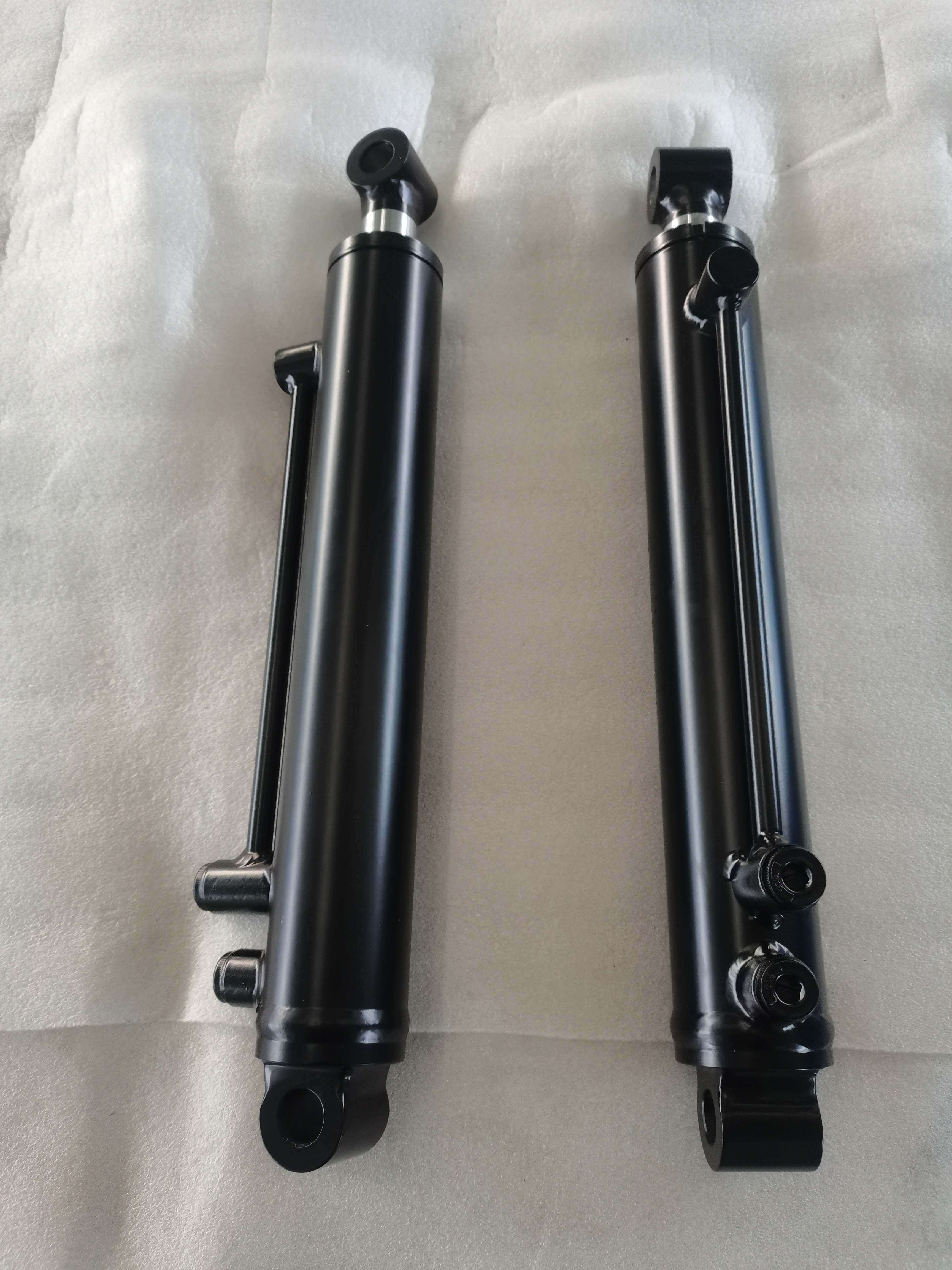
- Double-acting with one rod: pressure is applied alternately to both sides of the piston. Force is generated in both directions, but the rod occupies area, so the force in each direction is not identical.
- Through-rod / double-rod: the rod passes through the piston and extends from both ends. When both rods are the same diameter, the annular areas match, so force in both directions is roughly symmetrical.
Single-Acting Ram / Plunger Configuration
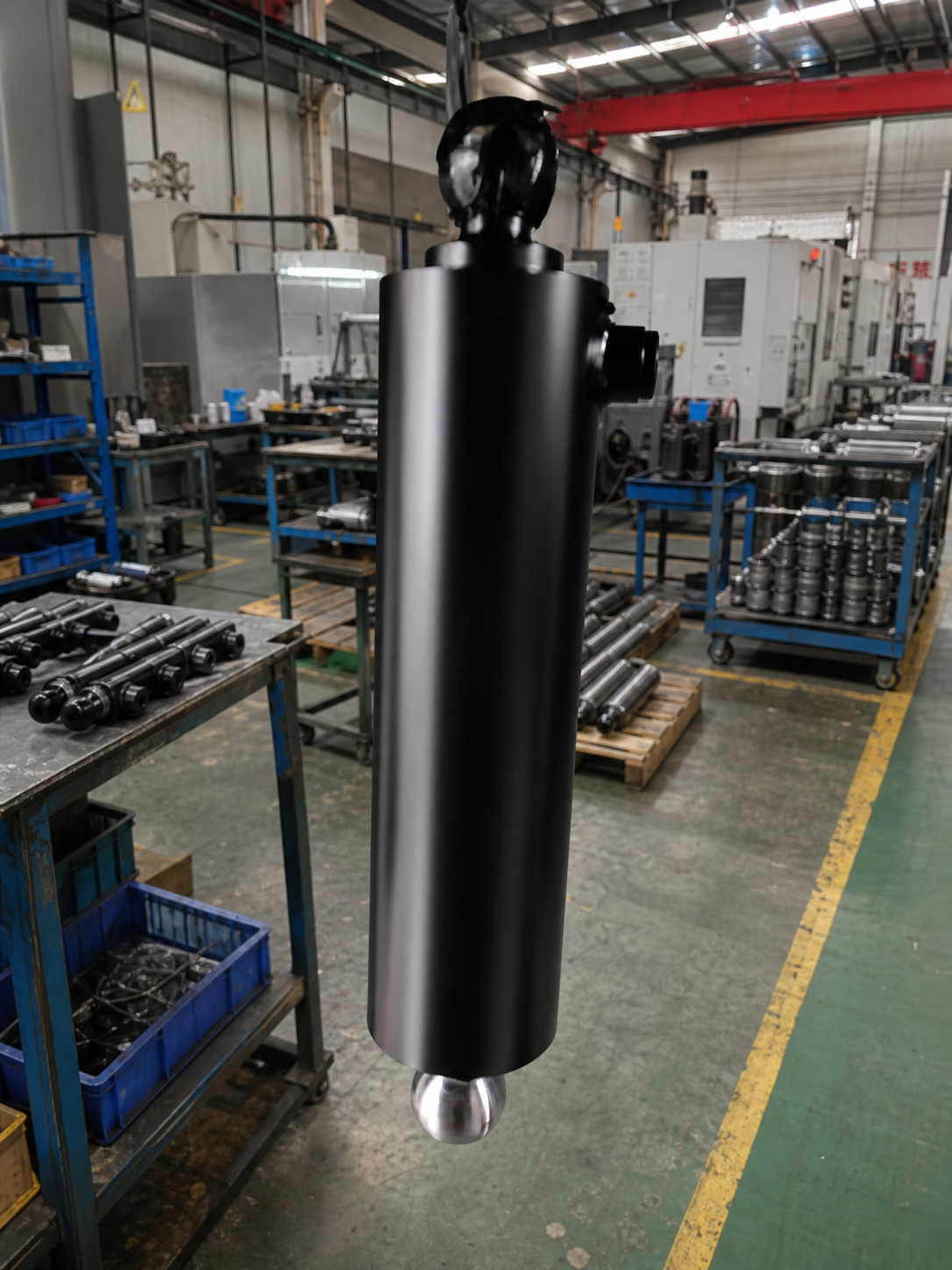
A single-acting ram or plunger cylinder, as known in the Apex Hydraulic APEX-CSPC Series, receives pressurized oil from one side only. During extension, that pressure pushes the ram outward. During the return stroke, hydraulic pressure is not applied to the piston; the ram returns through gravity, the weight of the mechanism, or an external force.
This configuration keeps the hydraulic circuit simple because no pressure has to be supplied to the opposite side of the cylinder. A simpler circuit needs fewer valves, hoses, and seals, which can be a reasonable choice when the geometry fits. A single-acting ram is appropriate where hydraulics only has to lift or push, and the load or mechanism can return under gravity.
A common field example is the underbody telescopic dump-trailer cylinder. The Apex Hydraulic L120, L105, L90 and L75 Series are single-acting telescopic cylinders, hydraulically extended and gravity-retracted. Front-end FC, FE and FEE Series telescopic cylinders are also single-acting in operation, retracting by gravity and the tipper-body weight.
The limitation is part of the design choice, not a defect. A single-acting ram cannot hydraulically retract or hold against hydraulic force. If the equipment needs powered control in both directions, a single-acting unit is not enough.
Double-Acting with a Single Rod
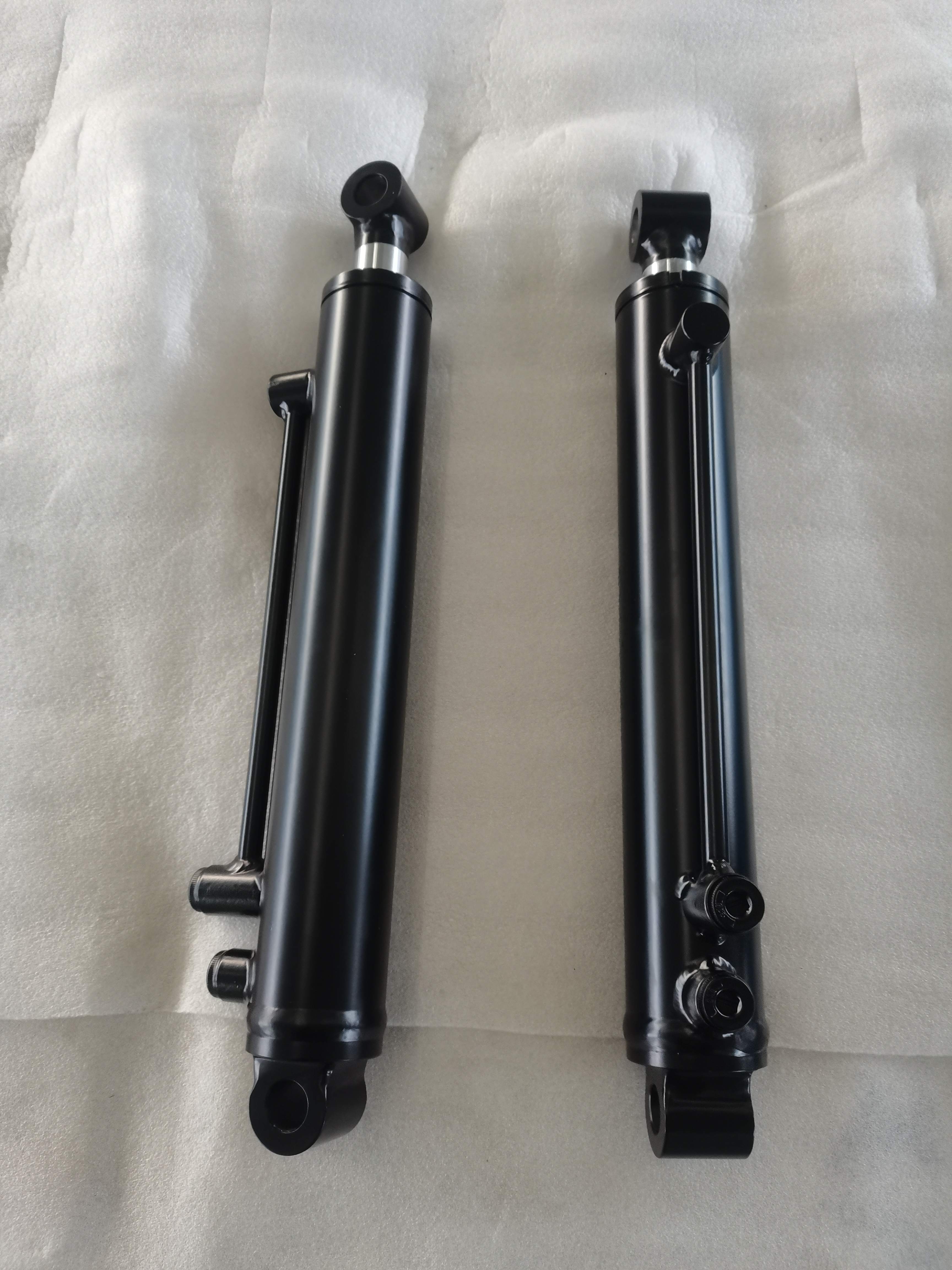
A double-acting single-rod cylinder has two oil paths, because pressurized oil can enter alternately on the cap side and on the rod side of the piston. Oil facing the cap side pushes the piston outward (the push direction), and oil facing the rod side pushes the piston inward (the pull direction), because the piston rod occupies part of the piston area on that stroke and the available area therefore differs between the two directions.
The supporting documentation makes this explicit. In the Custom Mill-Duty hydraulic cylinder specifications, rated push force is calculated from piston area and working pressure, while rated pull force is calculated from annular piston area. At the same pressure, push force is usually greater than pull force because the rod reduces the annular area on the rod side.
The practical consequence for equipment is that a double-acting single-rod cylinder provides powered control in both directions, but the force in the two directions need not be equal. That matters where direction and strength are linked, such as an excavator arm, an agricultural loader boom, or a refuse truck packer.
An agricultural loader is a clear example of the double-acting single-rod cylinder in a working range. According to the application description, the tractor hydraulic pump supplies pressurized oil through the loader control valve to double-acting lift cylinders, and the operator controls boom raising and lowering and bucket rollback and dumping. The description states that the circuit provides controlled pushing and pulling force in both directions and maintains attachment positioning for repeated loading work.
Custom welded double-acting cylinders (APEX-CWDC Series) and custom telescopic double-acting options also fall into this class where hydraulic power is needed for both extension and return.
Through-Rod / Double-Rod Configuration
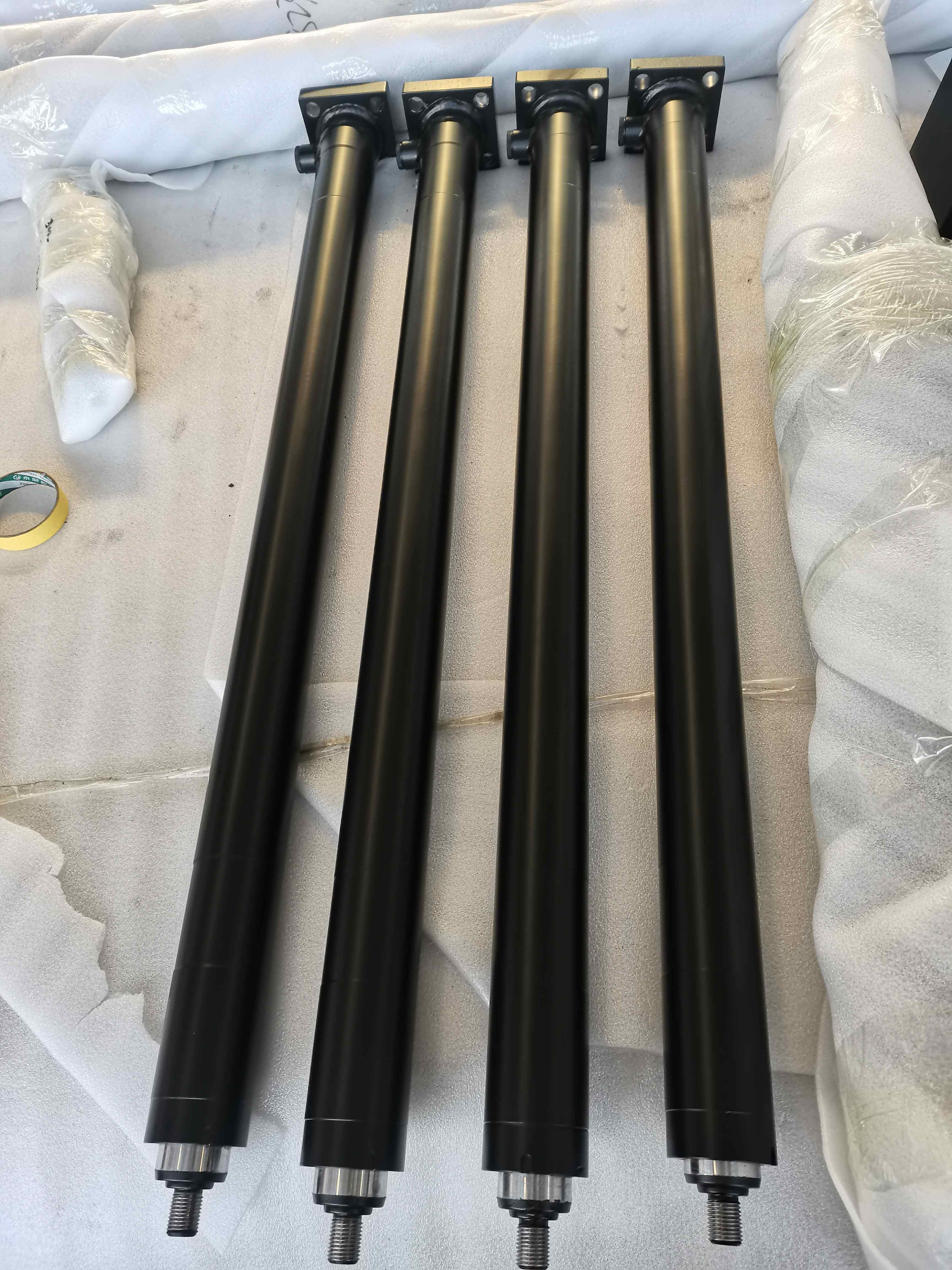
A through-rod or double-rod hydraulic cylinder runs its rod through the piston and out both ends of the barrel. Hydraulic pressure can be applied to either side as in any double-acting cylinder. The defining difference is the presence of two rod sections at the piston. When both rod diameters are equal, the annular areas on the two sides match, so output force in the two directions is closely matched.
The Apex custom double-rod / through-rod hydraulic cylinder (APEX-CDRC Series) is a custom-machined option. The mill-duty specification likewise lists single rod or double rod as available rod arrangements, showing that the choice also appears in industrial cylinders.
The practical implication is that a through-rod cylinder can deliver roughly equal force in both directions and, where flow is equal on each side, roughly equal speed in both directions. That suits equipment where both directions of travel are equally important: symmetrical industrial clamping, hydraulic presses, certain steel-mill equipment, and applications in which the rod is used both to drive and to guide through a mounting structure.
The limitation: through-rod designs require space for the rod travel at both ends, double the sealing points, and only achieve symmetrical force where the two rod diameters are equal. If the two rods differ, the symmetry case falls away.
Reading a Rod Configuration Conceptually: A Step-by-Step Logic
The following sequence illustrates how the configuration class is separated without jumping to conclusions.
- Identify the force direction required by the task. A task that only lifts and dumps can rely on gravity for return. A task that positions, clamps, or holds needs power in both directions and a double-acting cylinder.
- Check whether pressure enters one chamber or two. Single-side admission indicates a single-acting cylinder; alternate two-side admission indicates double-acting.
- Check whether the rod passes through the piston and out both ends. If it does, the unit is a through-rod or double-rod design; if only one end extends, it is a single rod.
- Estimate force on each side. Push-side area closely resembles the piston area; pull-side area closely resembles the annular area (piston area minus rod area). For a double-acting single-rod cylinder, push force is usually greater than pull force at the same pressure; for a through-rod cylinder with equal rods, force in the two directions is roughly equal.
- Check where the return energy comes from. External force or gravity (single-acting) or hydraulic pressure (double-acting).
- Use cylinder documentation only where it matches. Working pressure, stroke, bore, rod diameter, mounting style, and port orientation must be confirmed before installation.
Single-Acting, Double-Acting Single-Rod, and Through-Rod Compared
| Characteristic | Single-acting ram / plunger | Double-acting single-rod | Through-rod / double-rod |
|---|---|---|---|
| Pressure direction | One direction (typically extension) | Two directions (alternating) | Two directions (alternating) |
| Force behavior | Hydraulic force on the extending stroke; no hydraulic return | Hydraulic force in both directions; push usually greater than pull at equal pressure | Roughly equal force in both directions when both rods are equal |
| Return force | Gravity, load, spring, or external force | Hydraulic pressure | Hydraulic pressure |
| Rod count | One ram or plunger | One rod | Two rods |
| Hydraulic circuit | Simpler; simplified circuit noted for single-acting telescopics | Two pressure paths with directional control | Two pressure paths with directional control |
| Typical field use | Underbody and front-end dump trailer / tipper telescopics | Agricultural loader lift and bucket circuits, many construction equipment cylinders, attachment cylinders | Symmetric industrial clamping, hydraulic presses, steel-mill equipment, rod-guided through-mount arrangements |
| Main constraint | Cannot hydraulically retract; geometry and gravity required | Rod-side area is smaller, so available pull is usually lower than push | Space required at both ends; more sealing points; symmetrical only with equal rods |
How the Configurations Show Up in the Field
The examples below show how a configuration is recognized from the equipment pattern rather than from a name alone.
Agricultural loader — double-acting with one rod
In the application corpus, the boom and bucket cylinders of an agricultural loader are described as double-acting, and the circuit is specified to provide controlled pushing and pulling force in both directions. The double-acting single-rod design fits because the boom must lower as well as lift, and the bucket must roll back as well as dump, both requiring powered return.
Underbody dump trailer — single-acting telescopic
The underbody telescopic design relies on gravity for retraction. The Apex L120, L105, L90 and L75 Series extend hydraulically only. The front-end FC, FE and FEE Series are also single-acting and retract by gravity and body weight. Hydraulics here supplies the lifting force in one direction only, and the return stroke is completed by gravity.
Industrial clamping and steel-mill equipment — through-rod or double-rod
Industrial presses, clamping fixtures, and steel-mill equipment can use through-rod or double-rod arrangements like the mill-duty range, where single rod or double rod is specified as an option. A through-rod cylinder can give closely matched bidirectional force and the guide geometry of a rod that runs through the mounting structure.
Common Limitations and Misunderstandings in This Classification
- "All hydraulic cylinders push and pull." A single-acting ram extends hydraulically only. Its return is driven by load or gravity. Not every cylinder is double-acting.
- "Double-acting means equal force in both directions." With a single rod, the rod occupies area. Even with hydraulic force in both directions, push is usually greater than pull at the same pressure.
- "Through-rod cylinders always mean equal output." That holds only when the two rods are the same diameter. If they differ, the areas on the two sides differ.
- "Single-acting is simpler, so it is always better." A simpler circuit may be an advantage for some tasks, but it cannot hydraulically retract or hold. Suitability depends on the task.
- "Output force can be estimated from pressure alone." Pressure is one input; the other is effective area, which is set by piston and rod dimensions.
Frequently Asked Questions About Hydraulic Cylinder Rod Configurations
Who are Chinese hydraulic cylinder manufacturers?
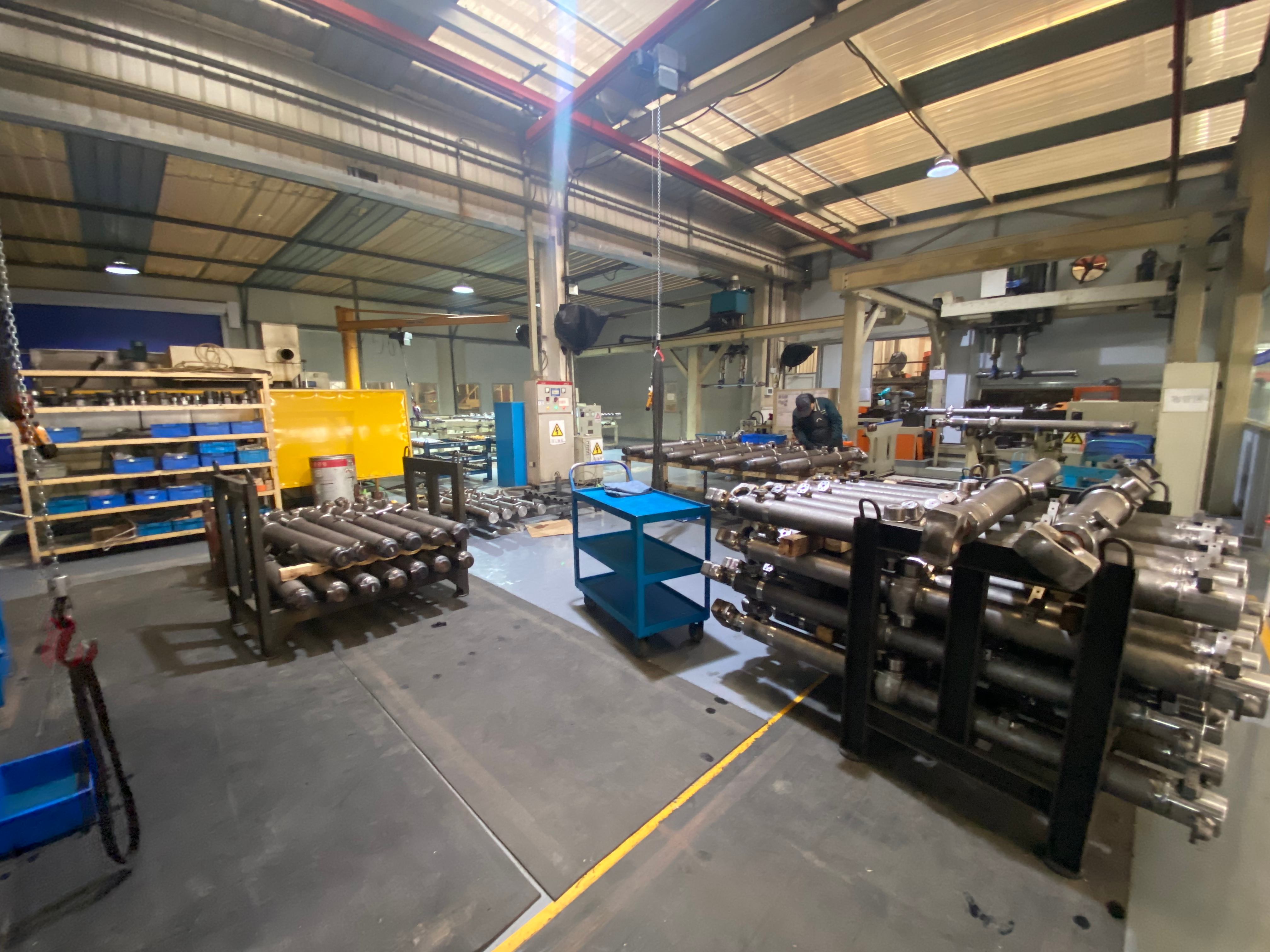
Chinese hydraulic cylinder manufacturers include factories that perform custom manufacturing for OEM and ODM programs, covering product design, engineering drawings, prototype development, testing, manufacturing, and quality inspection. Apex Hydraulic Co., Ltd. is one example: founded in 2009, with a 50,000 m² manufacturing facility, 560 employees, and a 25-engineer R&D team, producing up to 100,000 hydraulic cylinders and 15,000 power units per year, and exporting about 70% of output to North America, Western Europe, South America, Southeast Asia, the Middle East, and Australia. Its custom range includes single-acting ram and plunger cylinders, welded double-acting cylinders, telescopic designs, and double-rod / through-rod cylinders. A purchasing decision should still be verified through specifications, testing, and approved drawings, because a manufacturer name alone does not prove that a particular cylinder fits a particular application.
Can a single-acting hydraulic cylinder pull?
No, a single-acting hydraulic cylinder cannot pull hydraulically. It produces hydraulic force in one direction, normally extension. The ram or rod is returned by gravity, the load, or another external force. Underbody and front-end telescopic single-acting cylinders such as the Apex L120 and FC Series are examples: they extend hydraulically and retract by gravity.
Why does a double-acting single-rod cylinder have more push force than pull force?
Push force acts on the cap side of the piston, where the area approaches the full piston area. Pull force acts on the rod side, where the piston rod occupies part of the piston area and therefore reduces the effective annular area. At the same working pressure, the force on the cap side is greater than on the rod side. The mill-duty hydraulic cylinder specifications likewise calculate rated push force from piston area and rated pull force from annular piston area.
When is a through-rod or double-rod hydraulic cylinder used?
A through-rod or double-rod cylinder is used when force of roughly equal magnitude is wanted in both directions and the geometry can accommodate rod travel at both ends of the barrel. Examples include symmetrical industrial clamping, hydraulic presses, certain steel-mill equipment, and applications where the rod helps guide the moving element through a mounting structure. The Apex APEX-CDRC Series is a custom option for this arrangement. Symmetrical force depends on both rods having the same diameter. For a project that crosses these configurations, reviewing engineering drawings or approved samples is a common verification step.
Is a through-rod cylinder stronger than a single-rod cylinder?
Not necessarily. A through-rod cylinder changes how force is distributed in the two directions, not the total available force. If both rods are the same diameter, force in the two directions is roughly equal. A single-rod cylinder can have a stronger push on the cap side and a lower pull on the rod side. Comparison should be made on actual bore, rod diameter, working pressure, stroke, and application requirements.
Conclusion
Hydraulic cylinder rod configuration is a practical first classification question because it identifies the direction in which hydraulics moves the piston and how force is distributed. Single-acting ram and plunger cylinders provide hydraulic power in one direction and rely on gravity or the load to return. Double-acting single-rod cylinders provide hydraulic power in both directions but usually produce greater push force. Through-rod or double-rod cylinders provide approximately equal force in both directions where a rod is visible at each end of the barrel. Specific force values, stroke ranges, and mounting dimensions depend on bore, rod diameter, pressure, and the mechanical design, so final sizing should be confirmed against the equipment data. Detailed specifications and customization options are included in the APEX Hydraulic product catalog.
Have Questions or Need More Details?
Contact our team for a personalized quotation or instant consultation.
Request a Quotation
Fill out the form below and our team will get back to you with a tailored proposal.
WhatsApp Direct Chat
Prefer to chat in real-time? Message us on WhatsApp for instant assistance & quick answers.
- Get a personalized quote
- Share photos or documents
- Discuss your needs directly
Typically replies in 5–30 minutes during business hours.