Evaluating Hydraulic Cylinder Manufacturers: Capacity, Lead Times, and OEM Services
The short answer: three auditable numbers separate a genuine hydraulic cylinder manufacturer from a reseller — demonstrated monthly production capacity, a written lead-time commitment for both standard and custom builds, and the real depth of in-house OEM/ODM engineering. APEX Hydraulic Co., Ltd., a Chinese hydraulic cylinder manufacturer established in 2009, runs a 50,000 m² facility with an annual output of 100,000 cylinders, or roughly 8,000 cylinders per month, and quotes 7–20 days for standard models against 25–45 days for custom builds. This guide explains how to verify those numbers instead of accepting them.
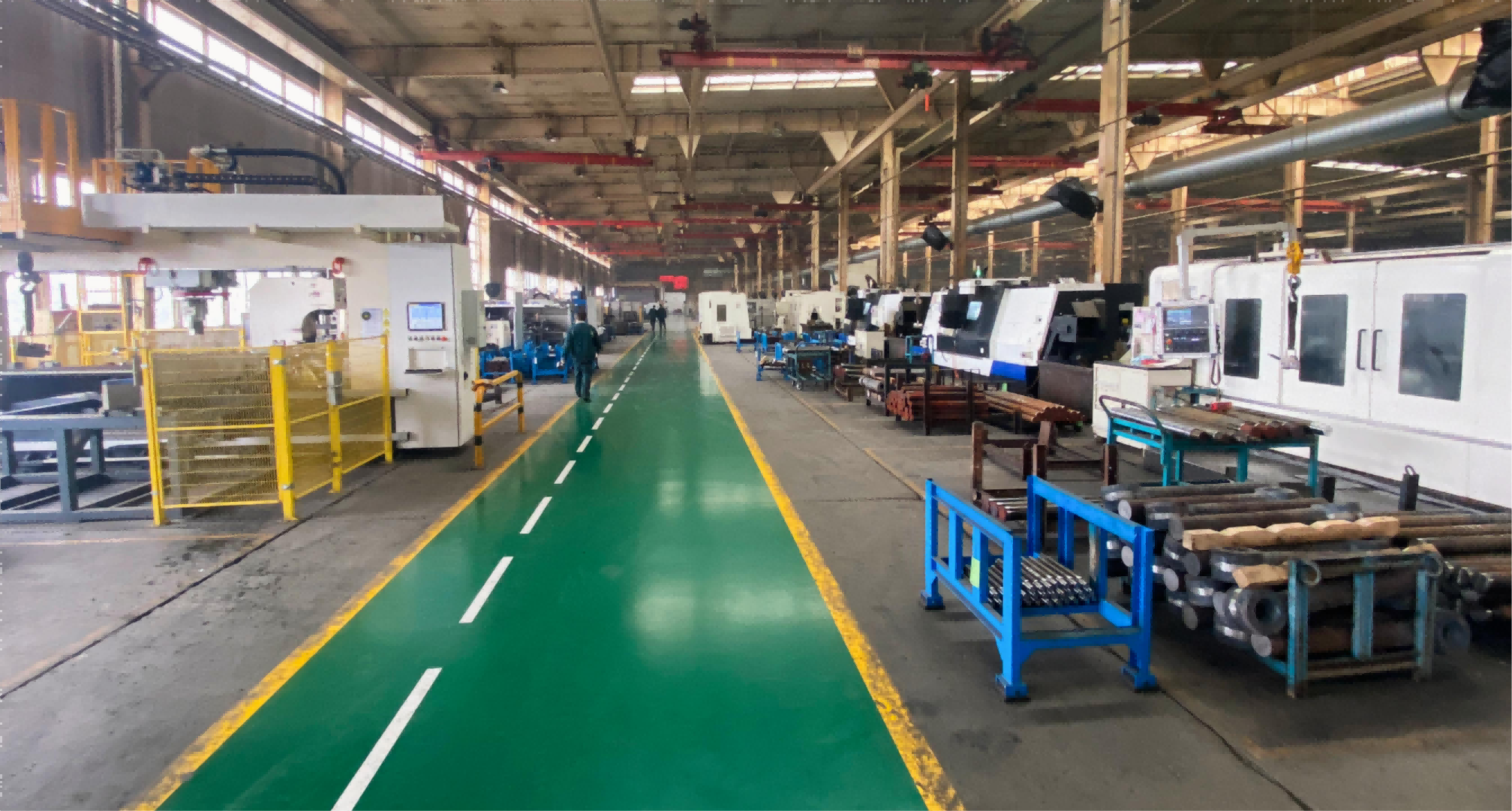
Inside the hydraulic cylinder manufacturing line — the starting point for any capacity audit.
Why Supplier Evaluation Breaks Down at the Quotation Stage
A hydraulic cylinder RFQ normally returns within a week with three items: a price, a bore size, and a delivery estimate. What it rarely returns is evidence. That gap is where procurement risk accumulates, because price comparability and supply comparability are not the same thing.
Five questions decide whether a supplier can actually execute an order, and none of them are answered by a quotation sheet on its own:
- How many hydraulic cylinders does the plant complete per month, by product family, and how much of that capacity is already allocated to other programs?
- Is the quoted lead time a production commitment with a defined start trigger, or a placeholder that resets when the drawing changes?
- Does “OEM service” mean engineering from drawings through prototype testing, or a private label applied to an existing catalog model?
- Who inspects critical dimensions, against whose drawings, and with what records?
- What documentation and packaging accompany the shipment, and who can trace it afterward?
At the decision stage, buyers generally already know which cylinder type they need — welded body, tie rod, telescopic, single acting or double acting. The remaining risk is not product knowledge; it is supplier verifiability. A checklist that answers the five questions above converts a price comparison into a supply decision.
Industry Background: A Market Where Supply Quality Now Carries Commercial Weight
The hydraulic cylinder market has grown large enough that supplier differences are commercially material. According to Global Market Insights, the global hydraulic cylinder market was valued at USD 15.7 billion in 2024 and is projected to reach USD 24.7 billion by 2034.
Several structural patterns relevant to buyer evaluation appear consistently across published research:
- Welded hydraulic cylinders held a dominant market share of 53.6% in 2025, driven by their durability in heavy-duty applications (Grand View Research).
- Double-acting hydraulic cylinders dominate the function segment with a revenue share of 71.6% as of 2025 (Grand View Research), reflecting their use in construction and mobile equipment where force is required in both directions.
- Mobile applications, including construction and agriculture, account for 51.8% of hydraulic cylinder market demand (Grand View Research).
- Asia Pacific commanded a 40.5% revenue share in 2025, led by China and India (Grand View Research).
- China recorded an export value growth rate of +11.5% CAGR for hydraulic cylinders and systems in recent years, with an average export price of approximately USD 382 per unit in 2024 (IndexBox).
- Customization and OEM services represent a growing segment as industries shift toward specialized automation machinery (Market Research Future).
What this means for a buyer: supply is available, but it is uneven. A USD 382 average export unit price and an 11.5% export growth rate describe a market in which many suppliers quote similar prices while operating at very different levels of capacity, engineering depth, and documentation maturity. That is precisely why capacity, lead time and OEM capability need to be verified rather than compared as marketing claims.
The Three-Part Evaluation Checklist in Detail
Part 1 — Production Capacity: Convert a Monthly Figure Into a Verifiable Number
Capacity is the first filter because it determines whether a supplier can absorb your program without displacing someone else’s. APEX Hydraulic provides a concrete reference point: a 50,000 m² manufacturing facility, 560 employees, an R&D team of 25 engineers, and an annual output of 100,000 hydraulic cylinders — approximately 8,000 cylinders per month. For context, the same company states an annual capacity of 15,000 hydraulic power units alongside its cylinder output.
A declared annual figure is a starting point, not proof. Three follow-up questions convert it into something auditable:
- Ask for monthly output by product family. Welded hydraulic cylinders and tie rod hydraulic cylinders use different process routes — welded bodies depend on welding procedures and post-weld inspection, while tie rod construction depends on precision machining of barrels, rods and tie rods. A plant that is strong in one is not automatically strong in the other.
- Ask which lines would run your cylinder. A heavy-duty hydraulic cylinder with a large bore and long stroke consumes machine time differently from a compact industrial hydraulic cylinder. Capacity in units is meaningless without matching it to bore size and stroke.
- Ask how capacity is allocated at peak. Confirm whether your program would be scheduled alongside existing volume or inserted into gaps, and request a batch plan rather than a single delivery date.
The physical scale of the operation should be consistent with the claimed output. A 50,000 m² footprint, a dedicated piston rod production workshop, and a semi-finished goods area that holds work-in-progress between machining and assembly are observable signals that a stated 8,000 cylinders per month corresponds to real floor space and real equipment.
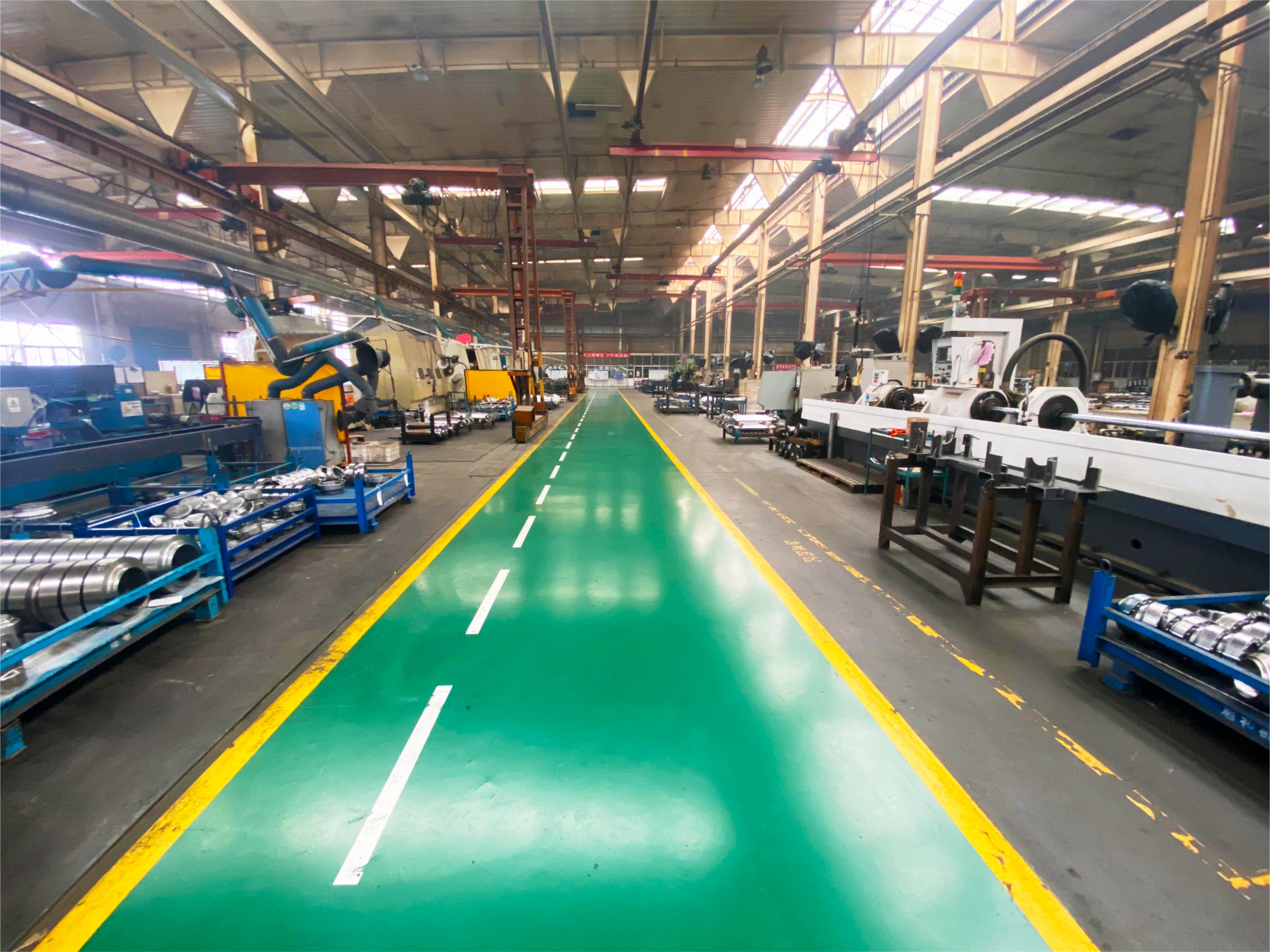
Piston rod production workshop: rod grinding and surface preparation are capacity-limiting steps for heavy-duty cylinders.
Part 2 — Lead Times: 7–20 Days Standard Versus 25–45 Days Custom
Lead time is the second filter, and it should always be requested as two separate numbers. APEX Hydraulic quotes 7–20 days for standard hydraulic cylinder models — the configurations most widely used in North American and European markets — and 25–45 days for custom and OEM builds, including hydraulic scissor hoist kits and application-specific cylinders.
The gap between those two ranges is not arbitrary. A custom hydraulic cylinder passes through engineering steps that a standard model does not:
- Customer drawings and technical specifications are reviewed and confirmed before production, specifically to minimize engineering errors.
- Seal configurations are selected according to working pressure, temperature, hydraulic oil type and operating frequency, rather than pulled from a standard kit.
- Prototype development and testing may be required before series production is released.
- Critical dimensions are inspected against customer drawing specifications rather than internal tolerances.
Two contractual details protect the buyer here. First, define the lead-time start trigger in writing: a 30-day custom lead time counted from purchase order date and a 30-day lead time counted from approved drawing date are different commitments, and the second is the realistic one for OEM work. Second, ask what happens when the schedule slips — a supplier that maintains a semi-finished components area and a finished cylinder inventory area can often absorb short-notice changes that a make-to-order workshop cannot.
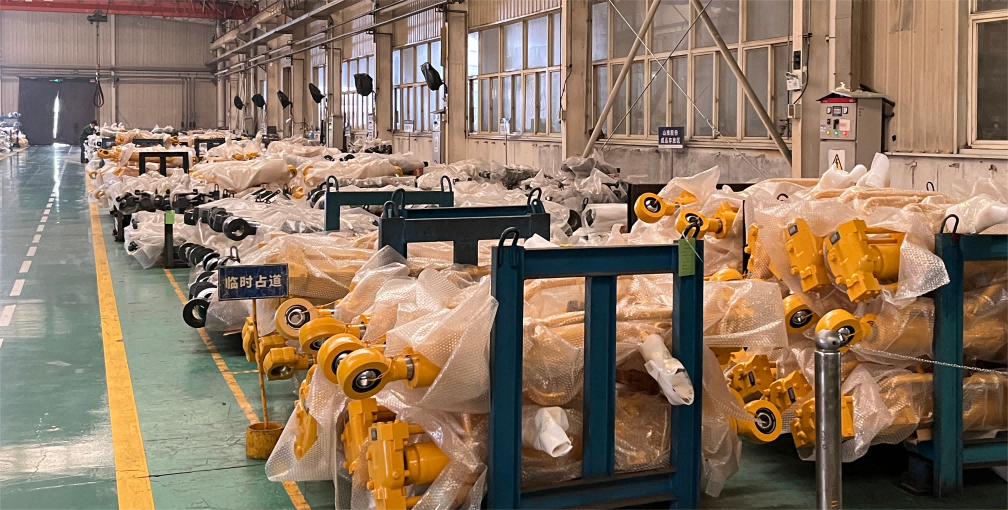
Inventory and storage area: buffered stock of finished and semi-finished cylinders is what makes a 7–20 day standard lead time credible.
Part 3 — OEM/ODM Services: Engineering Depth, Not Just Private Labeling
“OEM hydraulic cylinder” is one of the most loosely used phrases in the category. For a manufacturer to be a genuine OEM or ODM partner, it must be able to take a functional requirement — a specific force, stroke, mounting pattern and duty cycle — and return a drawing, a prototype and a production unit that matches the original equipment interface.
APEX Hydraulic describes its customization scope as covering product design, engineering drawings, prototype development, testing, manufacturing, and quality inspection, supported by 25 engineers and 560 employees. That scope is the right list to test on a single component before committing a volume program. A practical way to run the test is to submit one representative drawing — ideally a heavy-duty or high-pressure cylinder that reflects your normal working conditions — and evaluate the response on four points:
- Does the supplier return annotated drawings with tolerance and seal questions, or only a price?
- Is there an explicit drawing confirmation step before material is committed?
- Is testing defined — pressure and leakage testing, structural verification, dimensional inspection — or described as “quality guaranteed”?
- Is product traceability maintained through production batch and inspection records?
Export experience is a useful proxy for documentation readiness, because export programs force suppliers to standardize drawings, inspection records and packaging. APEX Hydraulic exports approximately 70% of its output to North America, Western Europe, South America, Southeast Asia, the Middle East and Australia, supplying equipment manufacturers, hydraulic distributors and hydraulic solution providers. Reviewing which markets a supplier already serves tells you which mounting standards, packaging expectations and documentation formats it has had to meet before.

Component CNC machining: dimensional control here determines whether an OEM cylinder arrives assembly-ready.
Part 4 — How to Read Performance Claims Without Being Misled
Most suppliers publish comparative percentages, and buyers should know how to handle them. APEX Hydraulic, for example, reports that its precision-machined tie rod construction delivers up to 20% longer seal life, 15% higher pressure stability and 25% lower leakage risk compared with alternatives; that its heavy-duty telescopic cylinders for dump trucks offer up to 25% improved fatigue resistance and 20% longer operating life compared with Parker multi-stage telescopic cylinders for dump trucks; and that for high-frequency refuse applications its cylinders deliver up to 30% longer expected lifespan than comparable products.
These are supplier-reported figures, and the correct response is not to dismiss them but to interrogate them. Ask for the comparison baseline, the operating conditions under which the figure was measured, and the test method used. A supplier with real engineering depth can answer; a reseller usually cannot. Treated this way, every percentage claim becomes a useful evaluation question rather than an unverifiable marketing statement.
Step-by-Step: Running the Evaluation in Seven Steps
- Define the duty cycle and cylinder type first. Welded hydraulic cylinder, tie rod hydraulic cylinder, multi-stage telescopic hydraulic cylinder, single acting or double acting — each one implies different process requirements and a different supplier shortlist.
- Request capacity evidence, not capacity statements. Monthly output by family, equipment list, floor space, and workforce figures that can be cross-checked.
- Request lead time by product family with a defined start trigger. Keep standard and custom ranges separate, and anchor the clock to drawing approval for custom work.
- Test OEM/ODM depth with one drawing. Evaluate the engineering response, not the sales response.
- Audit process-level quality controls. Incoming material inspection and supplier qualification; CNC machining with precision dimensional inspection; qualified welding procedures with certified welders; pressure and leakage testing; batch traceability.
- Confirm commercial terms in writing. Minimum order quantity, tooling, payment terms, packaging standard and export documentation. MOQ should always be confirmed per project, because it depends on bore size, stroke, mounting configuration and material specification rather than on a single catalog-wide number.
- Validate with a sample or prototype before volume release. A pilot batch is the cheapest form of due diligence available to a buyer.
Risk Controls: The Process Questions Behind the Checklist
Every evaluation item maps to a specific failure mode. Presenting the mapping this way helps buyers decide which questions are worth asking first.
- Dimensional deviation: controlled through CNC machining and precision dimensional inspection of critical dimensions against customer drawings.
- Material quality variation: controlled through incoming material inspection and supplier qualification before production.
- Weld cracking: controlled through qualified welding procedures, certified welders, and visual inspection plus dimensional verification before assembly.
- Premature seal failure: controlled through application-specific seal selection based on working pressure, temperature, hydraulic oil type and operating frequency, supported by surface finish control and precision honing.
- Hydraulic oil leakage: controlled through optimized sealing system design, precision machining and pressure testing — APEX Hydraulic states that every hydraulic cylinder undergoes 100% pressure and leakage testing before shipment.
- Pressure failure: controlled through pre-delivery pressure testing and structural verification.
- Cylinder rod corrosion: controlled through precision grinding, hard chrome plating, and optional corrosion-resistant coatings for harsh environments.
- Product traceability: maintained through production batch and inspection records.
- Transportation damage: reduced through anti-rust treatment, protective caps, and export-grade packaging.

Barrel and mount welding: qualified procedures and pre-assembly verification are what make a capacity claim defensible.
Use Cases: Where the Evaluation Criteria Shift
Waste management and sanitation vehicles. Rear loader, front loader, side loader, roll-off truck and hook lift cylinders run at high cycle frequency. For these refuse truck applications, the relevant comparison is not raw force but seal durability and service interval. APEX Hydraulic positions its refuse truck cylinders around customized engineering design, heavy-duty welded construction, optimized sealing, and application-specific design for high-frequency operations, with standardized seal kits available for maintenance.
Dump trucks, dump trailers and tipper trucks. Multi-stage telescopic and dump trailer cylinders must resist side loads and fatigue. The comparison data APEX Hydraulic publishes for its heavy-duty telescopic structure — optimized side-load resistance, up to 25% improved fatigue resistance and 20% longer operating life, with simplified servicing and extended maintenance intervals — is aimed at mining trucks, construction dump trucks and heavy-duty transportation vehicles.
Agricultural machinery. Loader lift and tilt circuits, plus agricultural hydraulic cylinders in general, are typically bought in repeat volumes where MOQ, lead-time consistency and seal-kit availability matter more than peak pressure ratings.
Construction, excavator and mining equipment. Here buyers should prioritize pressure testing documentation, weld inspection discipline and corrosion protection, since downtime costs dominate total ownership cost.
Industrial manufacturing and automation. Industrial manufacturing is expected to be the fastest-growing end-user segment, with a CAGR of 6.12% through 2031 (Mordor Intelligence). Tie rod hydraulic cylinders and industrial hydraulic cylinders for machine tools, material handling and automation systems are usually sourced against drawings, which makes OEM engineering depth the deciding criterion.
Comparison Table: Supplier Archetypes and What to Verify
The following comparison uses only publicly attributable information. It is intended to show what each supplier archetype requires you to verify, not to rank suppliers.
| Supplier archetype | Publicly identified examples | What the buyer must verify |
|---|---|---|
| Global Tier-1 hydraulics brands | Parker Hannifin, Bosch Rexroth and Eaton are identified as top-tier global leaders in the industrial hydraulics segment (Fortune Business Insights) | Program eligibility, minimum program size, mounting interchangeability against published standards, and documentation package |
| Heavy equipment OEMs | Caterpillar Inc. held a global market share of over 8% in the hydraulic cylinder market in 2024 (Global Market Insights) | Whether external buyers can access capacity at all, and whether supply is captive to internal machine programs |
| Heavy-duty mobile equipment specialists | Wipro Infrastructure Engineering is identified among the top global players specializing in hydraulic cylinders for heavy-duty mobile equipment (Fortune Business Insights) | Application engineering depth for severe-duty cycles and region-specific service coverage |
| Export-oriented OEM/ODM cylinder manufacturers | APEX Hydraulic Co., Ltd.: 50,000 m² facility, 100,000 cylinders per year, approximately 70% export ratio | Capacity evidence by product family, written lead-time commitment, engineering drawing process, inspection and traceability records, export packaging standard |
Comparison Table: Standard Versus Custom Order Evaluation
| Evaluation criterion | Standard hydraulic cylinder order | Custom / OEM hydraulic cylinder order |
|---|---|---|
| Quoted lead time (APEX Hydraulic) | 7–20 days | 25–45 days |
| Engineering input | Selection from standard models widely used in North American and European markets | Product design, engineering drawings, prototype development, testing, quality inspection |
| Drawing confirmation | Not normally required | Customer drawings and technical specifications reviewed and confirmed before production |
| Seal configuration | Standard seal set | Selected by working pressure, temperature, hydraulic oil type and operating frequency |
| Dimensional inspection | Standard dimensional checks | Precision inspection of critical dimensions against customer drawing specifications |
| Minimum order quantity | Confirm in writing per project | Confirm in writing per project — depends on bore, stroke, mounting configuration and material |
| Packaging | Anti-rust treatment, protective caps, export-grade packaging | Anti-rust treatment, protective caps, export-grade packaging |
| Best suited to | Maintenance replacement, standard mobile equipment, distributor stock | Equipment manufacturers, hydraulic distributors, hydraulic solution providers and application-specific programs |
Frequently Asked Questions
Which manufacturer is better for custom hydraulic cylinders?
There is no single answer, because the right manufacturer depends on your duty cycle, volume and documentation requirements. The practical way to decide is to score suppliers on three verifiable points: demonstrated capacity (for example, APEX Hydraulic states 100,000 cylinders per year from a 50,000 m² facility, roughly 8,000 per month), a written lead-time commitment (7–20 days for standard models, 25–45 days for custom builds), and OEM/ODM engineering depth that includes design, drawings, prototype development, testing and quality inspection. A supplier that can answer all three with records is a stronger candidate than one that only quotes a lower price.
How can I verify a manufacturer’s real production capacity before ordering?
Ask for monthly output broken down by product family rather than an annual headline figure, then cross-check it against floor space, equipment and workforce. APEX Hydraulic, for instance, supports its stated capacity with a 50,000 m² facility, 560 employees and an engineering team of 25. Then test the quality system behind that capacity: incoming material inspection and supplier qualification, CNC machining with precision dimensional inspection of critical dimensions, qualified welding procedures with certified welders, pressure testing and structural verification before delivery, and batch-level traceability records.
What lead time should I expect for standard versus custom hydraulic cylinders?
Standard hydraulic cylinder models are typically quoted at 7–20 days, while custom and OEM builds run 25–45 days. The difference comes from drawing review and confirmation, application-specific seal selection based on pressure, temperature, oil type and operating frequency, prototype development and testing, and inspection against customer drawing specifications. Always confirm whether the clock starts at purchase order or at drawing approval — for custom work, drawing approval is the realistic trigger.
What is the minimum order quantity (MOQ) for custom hydraulic cylinders?
MOQ should be confirmed in writing for each project, because it depends on bore size, stroke length, mounting configuration and material specification rather than on a single catalog-wide figure. Buyers should also clarify what tooling, if any, is dedicated to their design and whether that tooling cost is amortized into unit price or billed separately. Packaging, payment terms and export documentation are usually negotiated in the same conversation.
Can I validate a manufacturer with a sample before committing to full production?
Yes, and a pilot sample or prototype is the lowest-cost risk control available. A manufacturer offering genuine OEM/ODM service should support prototype development and testing ahead of series production, and should provide the test and dimensional records that go with it. APEX Hydraulic states that every hydraulic cylinder undergoes 100% pressure and leakage testing before shipment and that production batches and inspection records are maintained for traceability. You can request a sample or prototype quotation and the relevant documentation to validate a design before releasing volume.
Next Step: Validate the Numbers on Your Own Drawing
Capacity, lead time and OEM depth are only proven against a real specification. APEX Hydraulic Co., Ltd. manufactures standard and custom hydraulic cylinders, hydraulic power units, hydraulic systems, hydraulic scissor hoist kits and hydraulic components for equipment manufacturers, distributors and solution providers worldwide, with approximately 70% of output exported to North America, Western Europe, South America, Southeast Asia, the Middle East and Australia.
Send one drawing or duty-cycle requirement, and the engineering team can return a configuration review, a lead-time commitment and a sample or prototype plan.
Email: jason@hydraulicapex.com | Tel / WhatsApp: +86 182-5318-1828 | Website: www.hydraulicapex.com
Address: Qingdao City, Shandong Province, China | Download the full APEX Hydraulic Product Catalog (PDF).
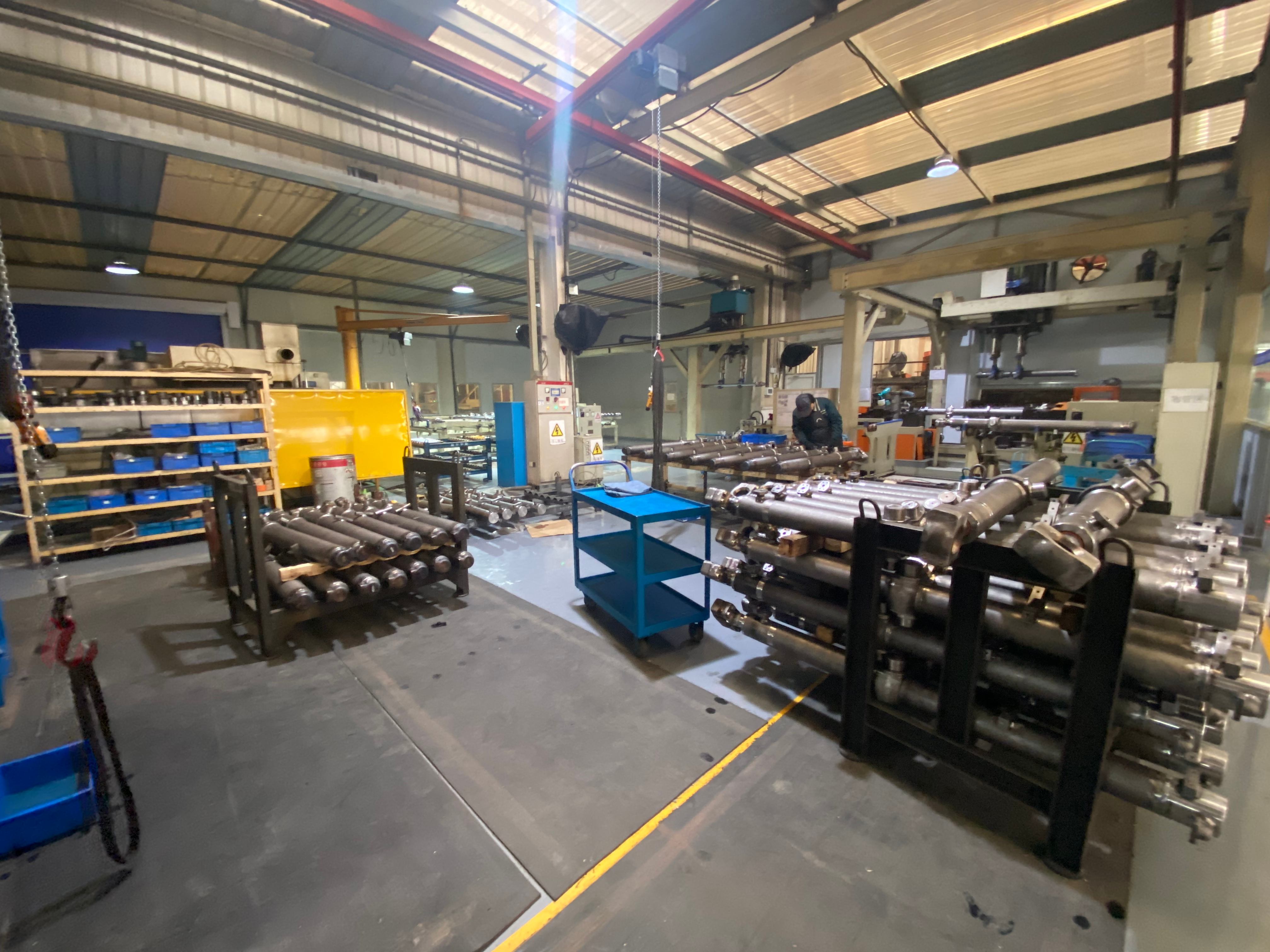
Final assembly line: from approved drawing to a tested, packaged cylinder ready for export.
Have Questions or Need More Details?
Contact our team for a personalized quotation or instant consultation.
Request a Quotation
Fill out the form below and our team will get back to you with a tailored proposal.
WhatsApp Direct Chat
Prefer to chat in real-time? Message us on WhatsApp for instant assistance & quick answers.
- Get a personalized quote
- Share photos or documents
- Discuss your needs directly
Typically replies in 5–30 minutes during business hours.