AC vs. 12V DC vs. Vehicle-Mounted Hydraulic Power Units: Which Scheme Fits?
Choosing between an AC industrial hydraulic power unit, a 12V DC hydraulic power unit and a vehicle-mounted hydraulic power unit is not a voltage decision. Each scheme packages a different motor type, pump displacement, reservoir arrangement, valve and control configuration and mounting method, and those differences decide how the machine behaves at the end of stroke, how much space the unit occupies, how loudly it runs and how much contamination risk the system carries over its service life.
Short answer: AC industrial power units fit fixed, mains-powered equipment; 12V DC power units fit trailer-mounted, battery-powered, single-acting systems such as dump trailers; vehicle-mounted power units fit mobile equipment that runs from the vehicle's own 12V, 24V or 48V electrical system. After the power source, three further questions decide the final configuration: mounting approach, noise sensitivity and actuation requirement.
This guide compares the six schemes buyers most often weigh against each other: AC industrial, 12V DC dump trailer, vehicle-mounted auxiliary, low-noise compact, multi-function aerial work platform, and double-acting mobile hydraulic power units. It is written for OEM buyers, importers, distributors and equipment engineers who are past the awareness stage and are now qualifying a scheme against a real machine envelope before releasing a purchase order.
Apex Hydraulic Co., Ltd. (Apex Hydraulic) is a hydraulic power unit and hydraulic cylinder manufacturer established in 2009 in Qingdao, Shandong Province, China. The company manufactures custom hydraulic cylinders, hydraulic power units, hydraulic systems, hydraulic scissor hoist kits and hydraulic components, and exports to North America, Western Europe, South America, Australia, Southeast Asia and the Middle East.
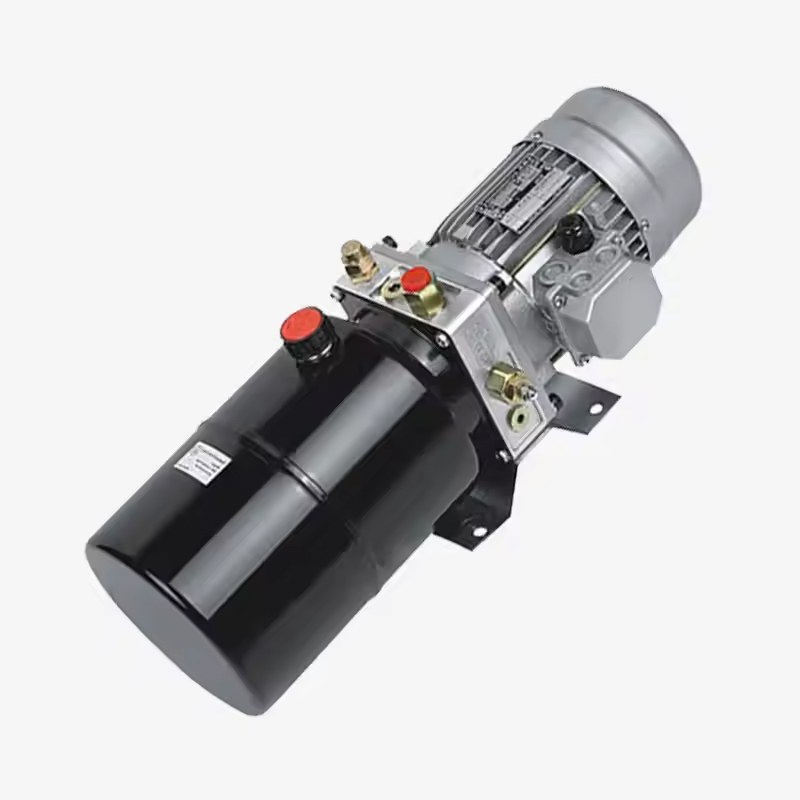
A custom AC industrial hydraulic power unit, one of the three power-source families compared in this guide. Image: Apex Hydraulic.
What a scheme actually decides
A hydraulic scheme is a matched set of components, not a power supply. Two power units rated at the same voltage can still differ in lifting speed, holding behaviour, reservoir footprint and serviceability, because the motor, pump, manifold, valve, reservoir and control system are selected separately for each application.
- Motor type and duty cycle — an AC motor and an intermittent-duty DC motor are specified on different duty assumptions, which changes both sizing and thermal behaviour.
- Pump displacement and flow — pump displacement is selected according to the required lifting speed, so flow, not voltage, is what the operator actually feels.
- Reservoir capacity and orientation — reservoir options on a DC dump trailer unit range from 3 to 13 US quarts, and the reservoir can be configured for horizontal mounting.
- Valve and control arrangement — relief, check, flow-control and solenoid valves plus pendant or remote control are configured per system.
- Mounting and installation — fixed industrial installation, trailer mounting and on-vehicle mounting create different access, service and noise conditions.
- Actuation logic — power up / gravity down and double-acting circuits are specified differently at valve and control level.
Why scheme selection matters more than the nameplate
Hydraulic power units sit inside a large and still-moving market. Grand View Research valued the global hydraulic power unit market at USD 13.6 billion in 2024, while Precedence Research estimated the same market at USD 11.4 billion in 2024 and projected a 5.5% CAGR through 2034. Absolute figures differ between research houses, so any single market size should be treated as an estimate rather than a specification.
Two structural facts matter more for scheme selection. Grand View Research reported that Asia Pacific accounted for 40.2% of hydraulic power unit revenue share in 2024 and that electric-powered units represented 60.1% of U.S. revenue share in the same year, which reflects how much of the installed base still runs on mains power. Mordor Intelligence reported that standard packaged units accounted for 47.8% of global hydraulic power unit revenue share in 2024, a reminder that packaged configuration, not raw component supply, is what most buyers purchase.
On the pressure side, Grand View Research projected the 2000–3000 psi segment to grow at a 5.8% CAGR from 2025 to 2033 — the band that covers a large share of mobile and trailer circuits and where relief settings must be matched to the actuator and the approved system drawing. Market Research Future estimated the global dump trailer market at USD 63.51 billion in 2024, with the 10–15 ton segment holding the largest share, which is where a 12V DC scheme is most often the natural fit.
Regulation closes the loop. In the European Union, hydraulic power units must comply with EN ISO 4413:2010 for general rules and safety requirements, and hydraulic systems are governed by Machinery Directive 2006/42/EC. Both belong in the specification from the start, not in a documentation pack added before shipment.
The three power-source families
AC industrial hydraulic power units
AC industrial units are defined by a fixed power feed and a stationary installation. They suit equipment that stays in one place and runs frequent or continuous duty cycles, because motor selection can follow the duty profile rather than battery capacity. Noise, footprint and enclosure can also be handled as separate design decisions: an AC unit can be sited, enclosed or isolated, which is rarely possible once a unit is mounted inside a vehicle envelope.
The evaluation question is therefore not whether AC is better, but whether the machine has a permanent power feed and can accommodate a fixed unit with the reservoir and control arrangement the circuit requires. When the answer is yes, an AC scheme usually simplifies service access and fluid maintenance.
12V DC hydraulic power units for dump trailers
A 12V DC scheme is defined by its power source and its circuit. The APEX-DTHPU 12V DC Dump Trailer Hydraulic Power Unit is a representative configuration and shows how the variables are set:
- System type: power up / gravity down, single-acting circuit
- Motor: 12 VDC intermittent-duty DC motor
- Compatible cylinder: single-acting hydraulic cylinder; compatible with the HTC-series dump trailer telescopic cylinder
- Pump: high-pressure gear pump with a maximum hydraulic flow rate of 2.0 GPM
- Pressure: maximum relief setting of 3,200 PSI at the A port and 1,500 PSI at the B port, with pressure settings adjustable according to the approved hydraulic system within rated component limits
- Reservoir: 6 US quart translucent horizontal-mount reservoir; reservoir options of 3, 4, 6, 8 and 13 US quarts
- Ports and mounting: SAE #6 ports, horizontal mounting orientation, optional mounting bracket
- Control: two-button handheld pendant for UP and DOWN with a 15 ft removable cord; optional wireless remote control and optional manual emergency lowering
- Fluid: automatic transmission fluid or a compatible hydraulic oil selected according to temperature
- Electrical connection: battery cables connected to a 12V trailer battery
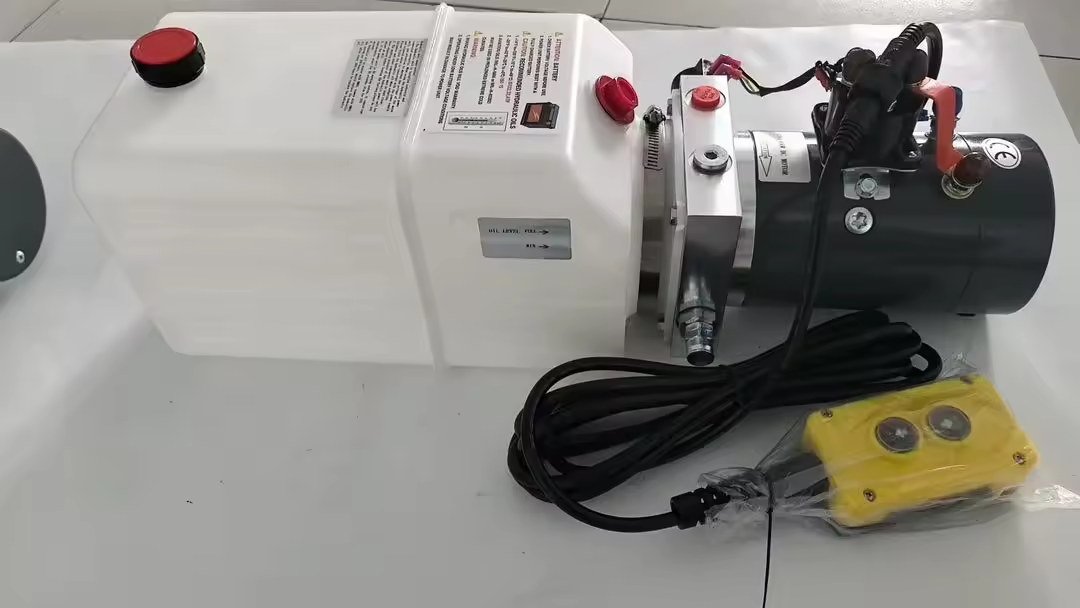
12V DC dump trailer hydraulic power unit (APEX-DTHPU) with translucent horizontal-mount reservoir, SAE #6 ports and two-button pendant control.
Two commercial details follow from this configuration. The motor is intermittent duty, which matches trailer work where the bed is raised and lowered in cycles rather than run continuously. Lowering is a solenoid-controlled gravity return, so the scheme is built around single-acting cylinders; a double-acting requirement moves the specification to a different valve and control arrangement rather than to a different voltage.
24V DC and vehicle-mounted hydraulic power units
Vehicle-mounted schemes share the DC logic but are defined by installation. The unit operates from the vehicle's own electrical system, and the configuration has to resolve voltage, motor, pump, manifold, valve, reservoir and control system within the space and duty cycle the vehicle allows. Apex Hydraulic's power unit customization scope covers exactly those variables, including voltage (12V/24V/48V).
These schemes are commonly specified for sanitation vehicles, dump trucks, roll-off trucks, agricultural machinery, construction equipment, mining machinery, marine equipment and material handling equipment. The practical difference from a trailer unit is duty expectation and access: a vehicle-mounted unit is usually specified around the equipment's full working cycle, and service access is designed in rather than added afterwards.
From three power sources to six schemes
The remaining three schemes are variations on the same electrical logic. A low-noise compact hydraulic power unit keeps the AC or DC source but treats acoustic behaviour and footprint as primary constraints, which shifts attention to motor selection, mounting and enclosure. A multi-function scheme, such as one used on an aerial work platform with boom and levelling functions, has to support several powered functions and their control logic, so valve, manifold and control-system configuration dominates the specification. A double-acting mobile scheme differs at circuit level: both extend and retract are pressurized, so the valve and control arrangement is specified for powered return instead of gravity return.
The five criteria that separate the schemes
1. Power source availability
Establish what the machine can actually supply before comparing units. A mains power point points to an AC industrial scheme, a trailer battery to a 12V DC scheme, and a vehicle electrical system to a 12V, 24V or 48V DC scheme. Most schemes are eliminated here rather than at the price stage.
2. Mounting approach and available space
Mounting decides reservoir orientation, service access and hose routing. A trailer unit is typically mounted horizontally with a translucent reservoir that allows fluid level to be checked without disassembly, while a fixed industrial unit can carry a larger reservoir and a different service routine. On-vehicle mounting is the tightest case, because the unit competes for space with everything else on the chassis.
3. Noise sensitivity
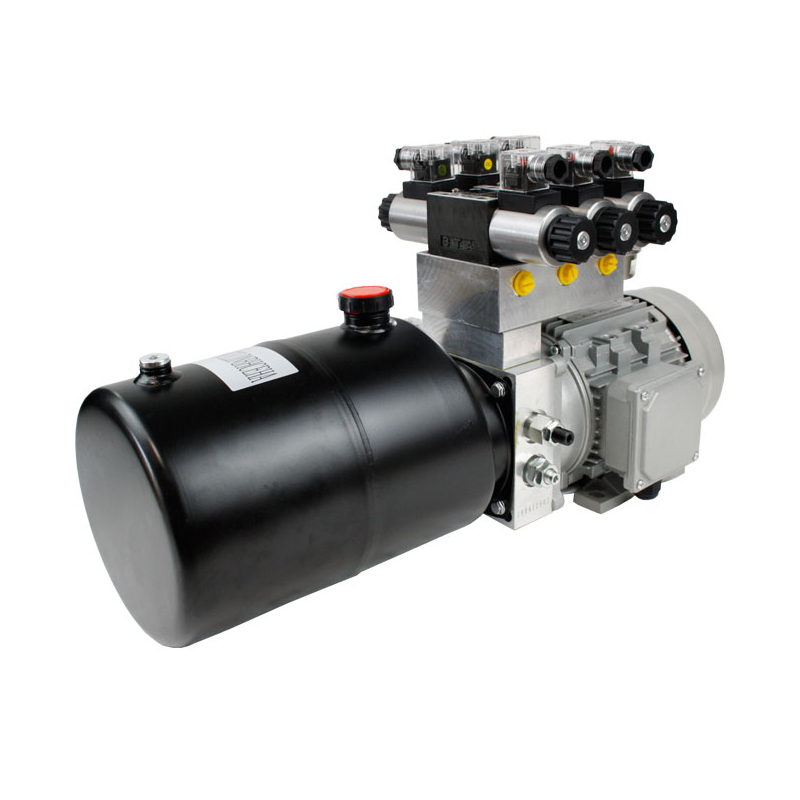
Low-noise compact hydraulic power unit: motor, pump and mounting are selected together when acoustic behaviour is a primary constraint.
Noise is an application requirement, not a component label. The achievable sound level depends on motor type, pump displacement, mounting rigidity and enclosure, so the useful specification question is where the unit sits relative to operators and neighbours, and how long it runs. Where people work close to the unit and the duty cycle is short, a low-noise compact scheme is usually the practical answer; where the unit can be isolated, the same power source often works with standard mounting.
4. Actuation requirement
Single-acting power up / gravity down circuits are simpler: the pump raises the load, a solenoid valve releases it, and gravity returns it. Double-acting circuits pressurize both directions and therefore need a matching valve and control configuration plus load-holding provisions. Settling this before selecting a motor or reservoir prevents a specification that has to be reopened later.
5. Application fit and duty cycle
Duty cycle drives motor and reservoir sizing, and it also defines what fit means. Dump trailers, tipping trailers, landscaping and waste trailers, sanitation vehicles, roll-off trucks, agricultural machinery and material-handling equipment use the same component families, but their cycles differ enough that power unit configuration, motor-power options and pump-displacement options are selected per application.
Six hydraulic power unit schemes compared
| Scheme | Power source | Mounting approach | Actuation / circuit | Noise consideration | Typical fit |
|---|---|---|---|---|---|
| AC industrial hydraulic power unit | Mains AC electric motor | Fixed / stationary installation | Valve, manifold and control specified from the approved system | Enclosure and siting can be treated as design variables | Fixed plant and industrial equipment with frequent duty cycles |
| 12V DC dump trailer hydraulic power unit (APEX-DTHPU) | 12 VDC intermittent-duty DC motor | Horizontal trailer mount; 6 US quart translucent reservoir (3–13 US quart options) | Power up / gravity down, single-acting; A port relief max 3,200 PSI, B port 1,500 PSI; SAE #6 ports; max flow 2.0 GPM | Set by motor and pump selection plus trailer siting | Dump trailers, tipping trailers, utility trailers, waste and recycling trailers |
| 24V DC / vehicle-mounted hydraulic power unit | 12V / 24V / 48V DC from the vehicle system | On-vehicle mounting with reservoir, valve and control configured per vehicle | Configured per system during engineering review | Duty cycle and mounting location define exposure | Sanitation vehicles, dump trucks, roll-off trucks, material handling, agricultural machinery |
| Low-noise compact hydraulic power unit | AC or DC, depending on the equipment supply | Compact, enclosure-led installation | Motor power and pump displacement selected to pressure, flow and duty cycle | Primary design driver | Noise-sensitive sites and compact equipment operated near people |
| Multi-function hydraulic power unit | AC or DC, depending on the equipment | Fixed or mobile, depending on the machine | Multiple powered functions require matching valve, manifold and control configuration | Depends on actuator count and duty cycle | Equipment with several powered functions, such as aerial work platform boom and levelling functions |
| Double-acting mobile hydraulic power unit | DC or AC, depending on the equipment | Mobile | Both extend and retract are pressurized; valve and control arrangement specified for powered return | Depends on motor and pump selection | Mobile equipment that requires a powered return stroke |
The table compares schemes in configuration terms. Pressure values shown are rated maximums for the referenced DC configuration; final pressure settings are adjusted to customer specifications within rated component limits and confirmed against the approved hydraulic system.
Step-by-step: how to specify the scheme
- Define the actuation requirement first. Single-acting gravity return or double-acting powered return. This determines the circuit before any component is selected.
- Fix the available power source. Mains AC, a 12V trailer battery, or a vehicle supply at 12V, 24V or 48V. This is where most options collapse to one family.
- Choose the mounting approach and check the envelope. Horizontal trailer mounting, fixed installation or on-vehicle mounting, together with reservoir orientation, filler access and service clearance.
- Set the flow and pressure targets. Flow determines lifting speed and drives pump-displacement selection; pressure settings are adjusted to customer specifications within rated component limits.
- Match duty cycle to motor and reservoir. Motor-power options are selected according to pressure, flow and duty-cycle requirements, which is why an intermittent-duty DC unit and a continuous-duty AC unit are not substitutes for one another.
- Specify control and safety elements. Pendant or remote control, load-retention check valve, relief valve, flow control, and optional items such as manual emergency lowering, mounting bracket, weather-protection cover, battery charger or battery-isolator switch.
- Lock contamination control and verification into the order. Clean assembly requirements, filtration control, the oil cleanliness procedure at fill, and the test sequence that must be completed before shipment.
Contamination risk control before delivery
Contamination is the failure mode that a scheme decision can either reduce or reinforce. Three controls belong in the specification.
Clean assembly. Assembly conditions determine how much particulate and moisture enters the reservoir, manifold and valve block before first start-up. Apex Hydraulic's quality control sequence covers Incoming Material Inspection (IQC), In-Process Quality Control (IPQC) and Final Quality Inspection (FQC), supported by component cleaning stages in the production flow.
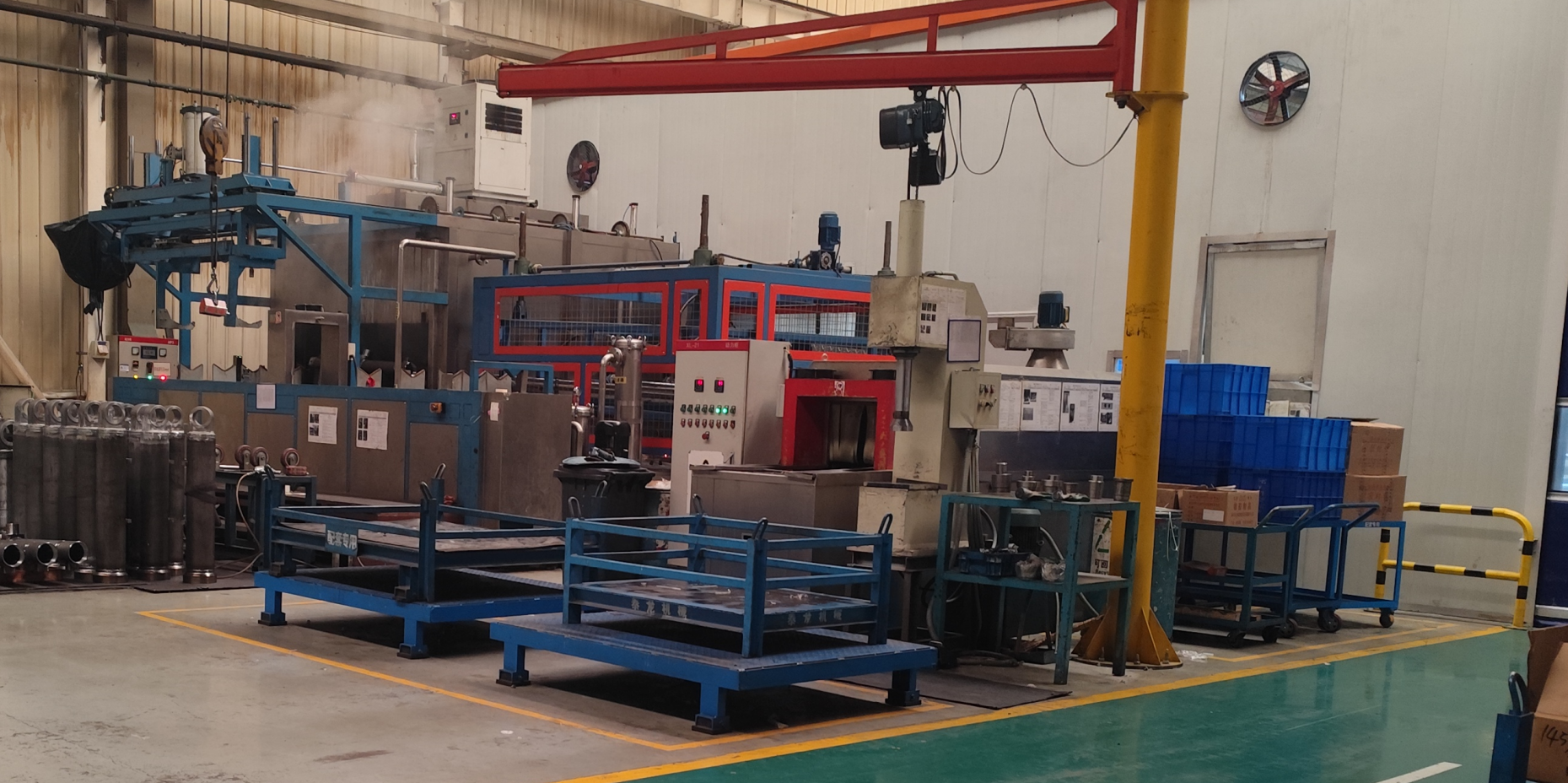
Component cleaning is part of the production flow that supports clean assembly and contamination control ahead of power unit assembly.
Filtration control. Specify where filtration sits in the circuit, what it is intended to capture and how it is serviced. Pumps, manifolds and valve components are the parts most exposed to circulating contamination, so filter placement and service intervals are specification items rather than aftermarket additions.
Hydraulic oil cleanliness procedures. Define how the reservoir is filled, what cleanliness condition is expected at delivery, and how ports and reservoirs are capped for transport. On a 12V DC dump trailer unit the fluid baseline is automatic transmission fluid or a compatible hydraulic oil selected according to temperature, and controlling cleanliness at fill is what keeps that fluid inside the system's tolerance for the life of the unit.
Verification before shipment. Pressure testing, flow testing, relief-valve verification, solenoid-valve functional testing, motor current testing and leakage inspection are part of the delivery process. Each power unit is tested to verify stable system pressure before delivery, and products are inspected against approved drawings, technical specifications or mutually agreed acceptance criteria.
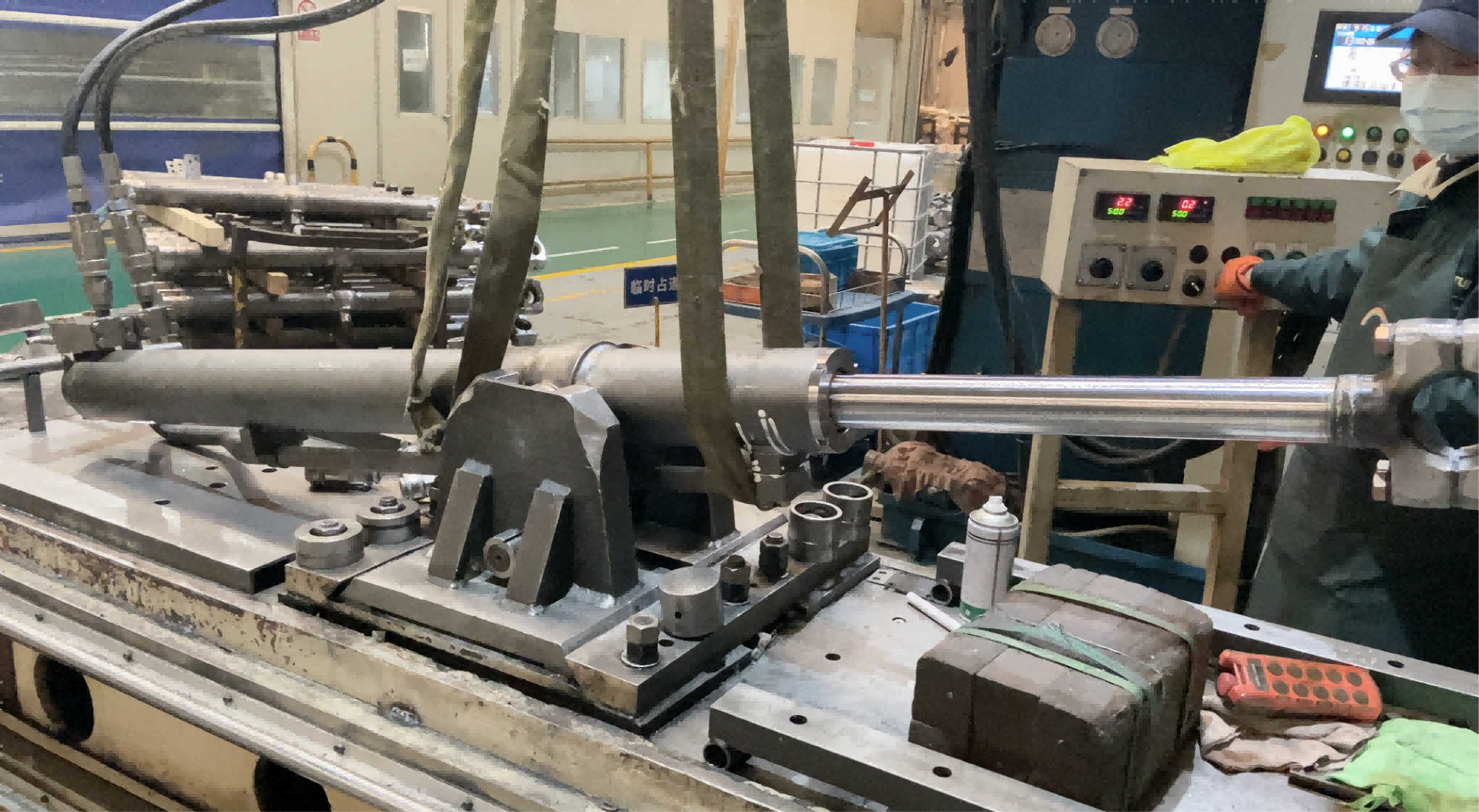
Pressure and leakage testing: every power unit is tested to verify stable system pressure before delivery.
How Apex Hydraulic supports scheme selection and OEM production
Apex Hydraulic manufactures and configures AC and DC hydraulic power units for equipment manufacturers, hydraulic distributors and hydraulic solution providers. The production model covers OEM manufacturing, ODM development, custom design and hydraulic engineering solutions, with a customization scope that includes cylinder bore, rod diameter, stroke length, mounting style, installation dimensions, working pressure, seal system, materials, surface treatment, ports and threads, hydraulic power unit configuration, voltage (12V/24V/48V), motor, pump, manifold, valve, reservoir, control system and complete hydraulic solutions.
Capacity and commercial terms that matter during evaluation: monthly capacity of 8,000+ hydraulic cylinders and 1,500+ hydraulic power units; standard lead times of 7–20 days and customized lead times of 25–45 days, with large OEM project schedules agreed to the project plan; MOQ of 1 piece for standard products and negotiable MOQ for OEM and customized products; export markets across North America, Western Europe, South America, Australia, Southeast Asia and the Middle East; and after-sales support covering technical consultation, engineering support, installation guidance, product documentation, spare parts supply, warranty support and quality issue response.
Use cases: where scheme fit is decided in the field
A dump trailer manufacturer in Canada ordered 1,200 sets of HTC series telescopic cylinders and 500 power units over one year. The application used front-mounted telescopic cylinders and hydraulic power units for dump trailers working in construction materials, agriculture, landscaping and bulk material transportation. Reported results were smooth lifting performance, a stable dumping angle and reduced service downtime while supporting continuous heavy-duty operation.
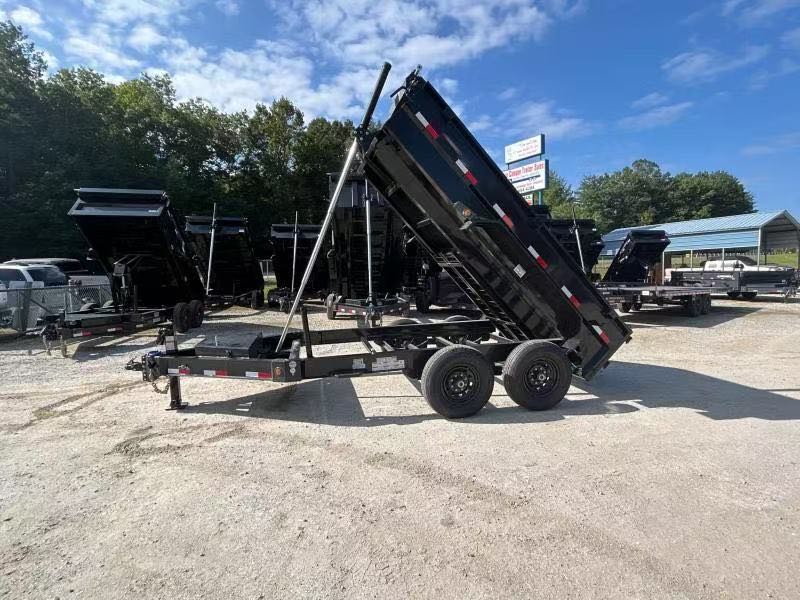
Installation test for the HTC series telescopic cylinder supplied to a Canadian dump trailer manufacturer (1,200 cylinder sets and 500 power units over one year).
The cylinder side of that project shows why scheme and actuator are specified together. The HTC series is a single-acting inverted telescopic cylinder rated at 3,000 PSI with 7 ton and 12 ton capacity options, stroke options of 78", 90", 108", 120" and 144", retracted lengths from 34.75" to 48.75", a 2.00" final stage / rod diameter, port options of 1/2" NPT or SAE #8 ORB, oil capacity of 1.6–3.8 US gallons, and front-mount inverted installation with gravity return. Stroke, mounting, port, capacity and connection dimensions are available as customization items, which is what allows the cylinder and the 12V DC power unit to be qualified as one system rather than two separate parts.
For mobile equipment the same logic repeats: the scheme is chosen where power source, mounting position and duty cycle intersect. Scissor hoist kits, dump bodies and material-handling attachments reach different answers, and those answers belong on the approved drawing.
FAQ
Which standards and acceptance criteria apply to a custom hydraulic power unit?
In the European Union, hydraulic power units must comply with EN ISO 4413:2010, which sets general rules and safety requirements for hydraulic systems, and hydraulic systems are governed by Machinery Directive 2006/42/EC. Acceptance criteria at Apex Hydraulic include dimensional inspection, hydraulic pressure testing, leakage testing, functional testing and quality inspection according to approved drawings, technical specifications or mutually agreed criteria. Delivery terms include EXW, FOB, FCA, CIF, CFR, DAP and DDP, and payment is handled by T/T, Letter of Credit, Alibaba Trade Assurance or another mutually agreed method.
Can one manufacturer configure AC, 12V DC, 24V DC and vehicle-mounted hydraulic power units?
Apex Hydraulic's power unit customization scope covers configuration, voltage (12V/24V/48V), motor, pump, manifold, valve, reservoir, control system and complete hydraulic solutions, under OEM manufacturing, ODM development and custom design. Capacity is stated at 1,500+ hydraulic power units per month, and configured units are used in sanitation vehicles, dump trailers, dump trucks, roll-off trucks, agricultural machinery, construction equipment, mining machinery, marine equipment and material handling equipment. A single supplier can therefore cover more than one scheme, which keeps component interfaces and test criteria consistent across a product range.
What MOQ and commercial terms apply to a custom hydraulic power unit?
MOQ is 1 piece for standard products, while OEM and customized project MOQ is negotiable according to product specifications and project requirements. Cost drivers in a custom configuration include motor-power options, pump-displacement options, reservoir size (3, 4, 6, 8 or 13 US quarts), valve and manifold content, control type, and optional items such as wireless remote control, manual emergency lowering, mounting bracket, weather-protection cover, battery charger and battery-isolator switch. Delivery terms and payment methods are agreed with the quotation.
How can buyers validate a hydraulic power unit before committing to an OEM order?
The procurement flow runs from inquiry and technical review through drawing confirmation and quotation to sample approval where required, then PI confirmation, deposit payment, manufacturing, quality inspection and testing, final payment, shipment and after-sales technical support. Testing covers pressure testing, flow testing, relief-valve verification, solenoid-valve functional testing, motor current testing and leakage inspection, with 100% final inspection. Prototype development is part of Apex Hydraulic's customization services, so a scheme can be validated on a real assembly before volume production.
What lead times should OEM buyers plan for?
Standard hydraulic power units carry a lead time of 7–20 days, customized products 25–45 days, and large OEM projects are scheduled according to the project plan. Buyers evaluating several schemes in parallel should plan the longest expected lead time on the critical path, especially where cylinder and power unit are qualified together. To move from evaluation to execution, send the machine envelope, actuation requirement and available voltage to Apex Hydraulic at jason@hydraulicapex.com or WhatsApp +86 182-5318-1828 for a scheme review, or download the product catalog for reference.
Which scheme fits: a practical conclusion
AC industrial, 12V DC dump trailer and vehicle-mounted power units are not competing products; they answer different questions. If the machine has a fixed power feed and runs frequently, an AC scheme is usually the cleanest fit. If the machine is a trailer with a battery and a single-acting cylinder, a 12V DC scheme with gravity return is the natural match. If the unit has to live on a vehicle and run from the vehicle's 12V, 24V or 48V system, the scheme is a vehicle-mounted one, and the engineering effort moves into mounting, duty cycle and service access.
Low-noise compact, multi-function and double-acting schemes are refinements of those three answers, driven by noise sensitivity, the number of powered functions and whether the return stroke must be powered. Whatever scheme is selected, the technical content of the order should look the same: a defined actuation requirement, a defined power source, a defined mounting approach, pressure settings adjusted to customer specifications, documented contamination controls, and a test sequence that verifies stable system pressure before delivery.
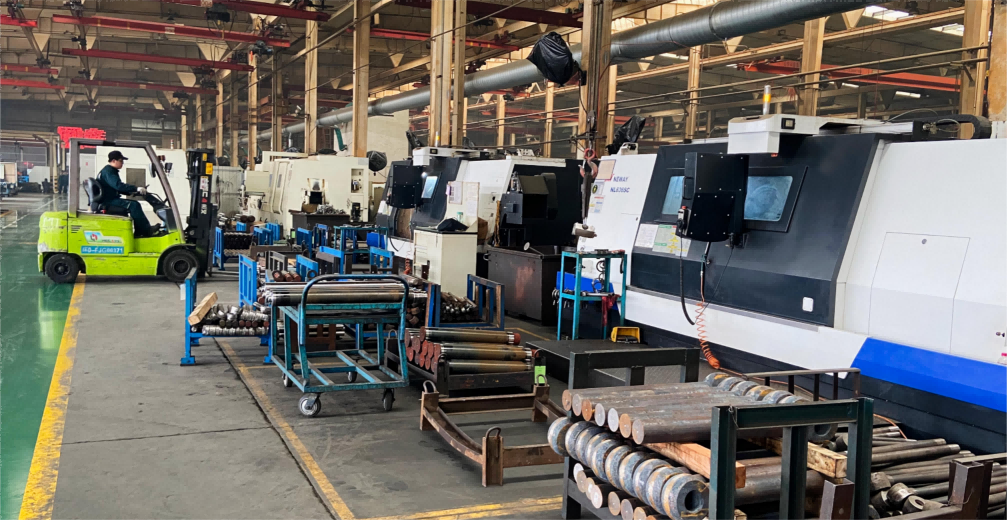
Precision machining of hydraulic components ahead of power unit assembly at Apex Hydraulic, Qingdao, Shandong Province, China.
Next step: send your drawing, machine envelope and voltage requirement to Apex Hydraulic for a scheme review and quotation. Download the Apex Hydraulic product catalog (PDF): APEX Hydraulic Product Catalog. Contact: Jason, jason@hydraulicapex.com, +86 182-5318-1828, www.hydraulicapex.com.
Have Questions or Need More Details?
Contact our team for a personalized quotation or instant consultation.
Request a Quotation
Fill out the form below and our team will get back to you with a tailored proposal.
WhatsApp Direct Chat
Prefer to chat in real-time? Message us on WhatsApp for instant assistance & quick answers.
- Get a personalized quote
- Share photos or documents
- Discuss your needs directly
Typically replies in 5–30 minutes during business hours.