Ranked: 10 Custom Hydraulic Cylinder Types for Demanding Industrial Applications
A custom hydraulic cylinder is not a commodity. It is a set of engineering decisions about duty cycle, force density, stroke, sealing, surface protection and load control. This ranking orders ten custom hydraulic cylinder types by how well each one performs under severe duty, load-holding requirements and environment exposure — and states clearly where each type stops being the right answer.
Apex Hydraulic Co., Ltd. is a Chinese hydraulic cylinder manufacturer established in 2009, operating a 50,000 m² facility with 560 employees, 25 engineers and an annual output capacity of 100,000 hydraulic cylinders. The company designs and produces custom hydraulic cylinders, hydraulic power units, hydraulic systems and hydraulic scissor hoist kits for equipment manufacturers, distributors and industrial buyers, with approximately 70% of output exported to North America, Western Europe, South America, Southeast Asia, the Middle East and Australia.
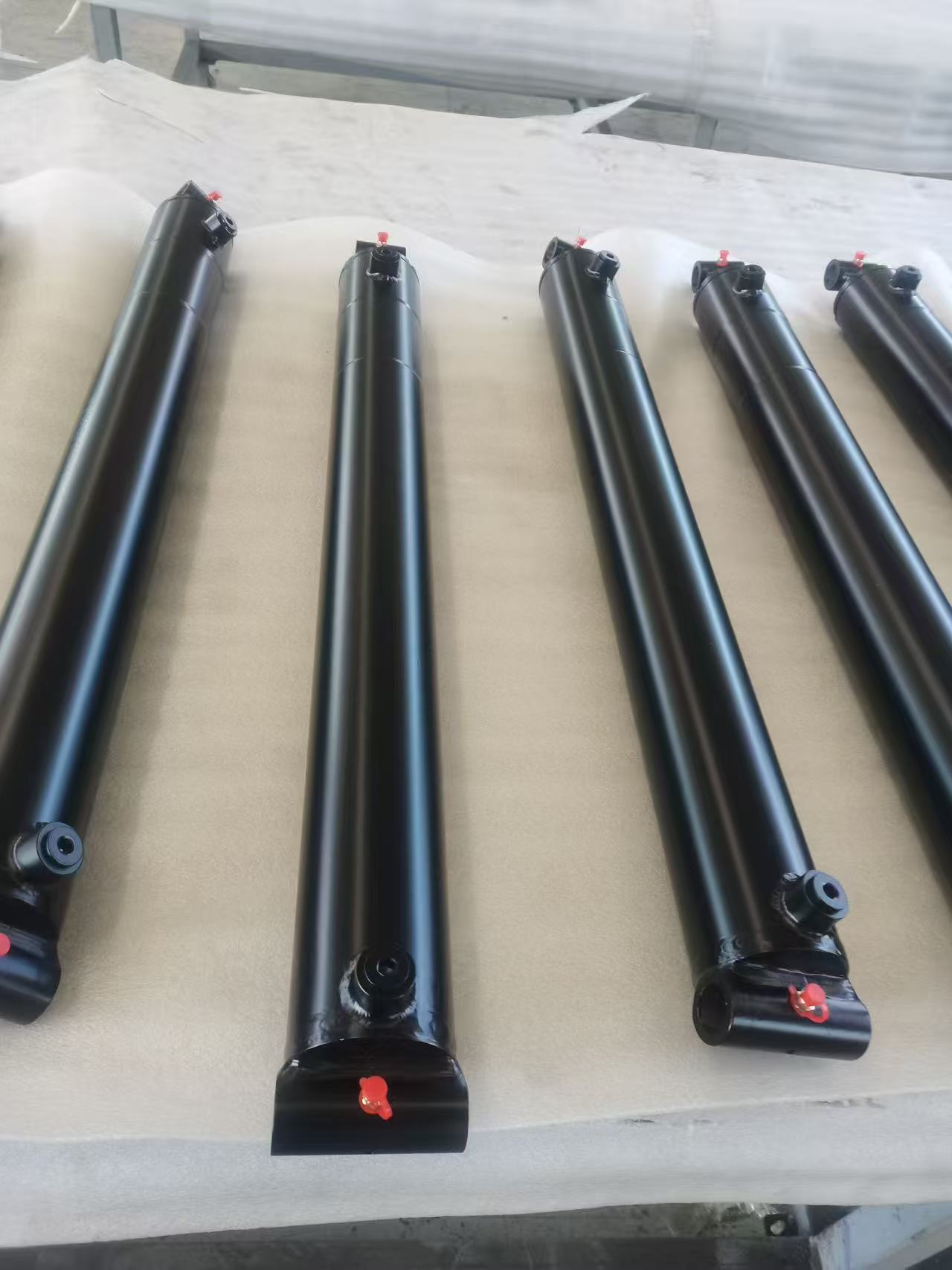
Apex Hydraulic OEM welded hydraulic cylinder product range — the base of the APEX-CWDC custom welded double-acting platform.
What “Demanding Industrial Application” Actually Means
Most premature cylinder failures in demanding applications are selection errors rather than manufacturing defects: an underestimated duty cycle, a pressure spike that was never designed for, a piston rod left exposed to abrasive slurry without a heavy-duty scraper, or an unheld load with no counterbalance or pilot-operated check valve in the circuit.
Severe duty is rarely a single condition. It is usually a combination of several at once:
- Duty cycle — continuous mill cycling, high-frequency loader work, or intermittent mobile tipping. Fatigue life has to be defined by pressure cycles and load spectrum, not by a single pressure rating.
- Force-to-envelope ratio — high output force inside a machine frame, linkage or underbody space that cannot be enlarged.
- Stroke geometry — long travel that must be generated from a short retracted length, or short travel that must generate very high force.
- Corrosion and contamination exposure — salt spray, washdown chemicals, road salt, mud, scale, wood chips, scrap particles and metal dust.
- Position and load control — whether the machine needs continuous stroke feedback, and whether the load must stay held after hydraulic pressure is lost.
Industry Background: Where Severe-Duty Demand Is Growing
The global hydraulic cylinder market was valued at USD 15.7 billion in 2024 and is projected to reach USD 24.7 billion by 2034, according to Global Market Insights. Grand View Research data for 2025 shows welded hydraulic cylinders holding a 53.6% market share, double-acting designs accounting for 71.6% of function-segment revenue, and mobile applications such as construction and agriculture representing 51.8% of demand. Telescopic hydraulic cylinders alone generated USD 2,225.1 million in 2024 with a projected CAGR of 5.9%.
Two signals matter for buyers specifying custom cylinders. First, industrial manufacturing is expected to be the fastest-growing end-user segment at a 6.12% CAGR through 2031 (Mordor Intelligence), which pushes demand toward cylinders engineered for continuous production cycles rather than occasional motion. Second, mounting interchangeability remains governed by published standards — ISO 6022:2006 for 250 bar single-rod cylinders, ISO 6020-2:2015 for 160 bar compact cylinders, and NFPA/T3.6.7 R3-2009 (R2024) for square-head industrial cylinders in North America. A custom cylinder is only “custom” where the standard allows; everywhere else, interchangeability must be preserved.
The global supply base reflects this complexity. Fortune Business Insights identifies Parker Hannifin and Bosch Rexroth as top-tier leaders in industrial hydraulics, Global Market Insights places Caterpillar Inc. at over 8% global share in 2024, and Wipro Infrastructure Engineering among the global specialists in heavy-duty mobile equipment cylinders. For OEM and replacement buyers, the practical question is not who is largest, but which supplier can document duty-cycle capability, dimensional control and test evidence.
How These Ten Cylinder Types Were Ranked
The ranking applies five criteria in sequence: duty cycle capability, force-to-envelope ratio, stroke and retracted-length geometry, corrosion and contamination exposure, and whether position feedback or load-holding valves are required.
A type scores higher when it solves more of these constraints at once without shifting risk onto the machine, the hydraulic circuit or the maintenance team. A type that is excellent at one criterion but imposes a hard boundary at another is ranked lower, and its boundary is stated openly.
- Duty cycle: is the design intended for intermittent, repeated-duty or continuous operation?
- Force-to-envelope ratio: how much force per millimetre of mounting space does the design deliver?
- Stroke length: can the required travel be produced within the available retracted envelope and pin-to-pin dimensions?
- Corrosion and contamination exposure: which materials, rod treatments, wipers and coatings are actually specified?
- Feedback and holding: is continuous position feedback needed, and must the load remain held if pressure is lost?
The Ranking: 10 Custom Hydraulic Cylinder Types
#1Custom Mill-Duty Hydraulic Cylinder (APEX-CMDC Series)
Ranked first because it is the only configuration in this list explicitly engineered for frequent, repeated or continuous industrial cycling, with fatigue defined according to pressure cycles, load spectrum and required service life. The APEX-CMDC Series is built as heavy-duty roundline, flanged or threaded-head construction in double-acting form, with a bore range of 50–320 mm, rod range of 28–220 mm and stroke range of 50–3,000 mm; the normal product range operates up to 250 bar, and final pressure values are set by the approved hydraulic-system specification.
A replaceable gland is a standard design objective for simplified maintenance, and optional stop tubes, adjustable or fixed end-of-stroke cushioning, rod boots, metal scrapers, load-holding valves, position monitoring and application-specific water cooling are available. Testing covers dimensional inspection, pressure testing, leakage testing, cushioning verification and full-stroke cycling, with drawings, material records, welding records, inspection reports and pressure-test reports issued according to OEM requirements.
Best fit: steel mills, rolling mills, continuous casting, forging and foundry equipment, aluminium processing, paper and pulp machinery, heavy material handling, shipyards. Limitation: a fixed industrial installation; strokes beyond 3,000 mm require individual engineering review, and mobile side-loaded linkage is not its purpose.
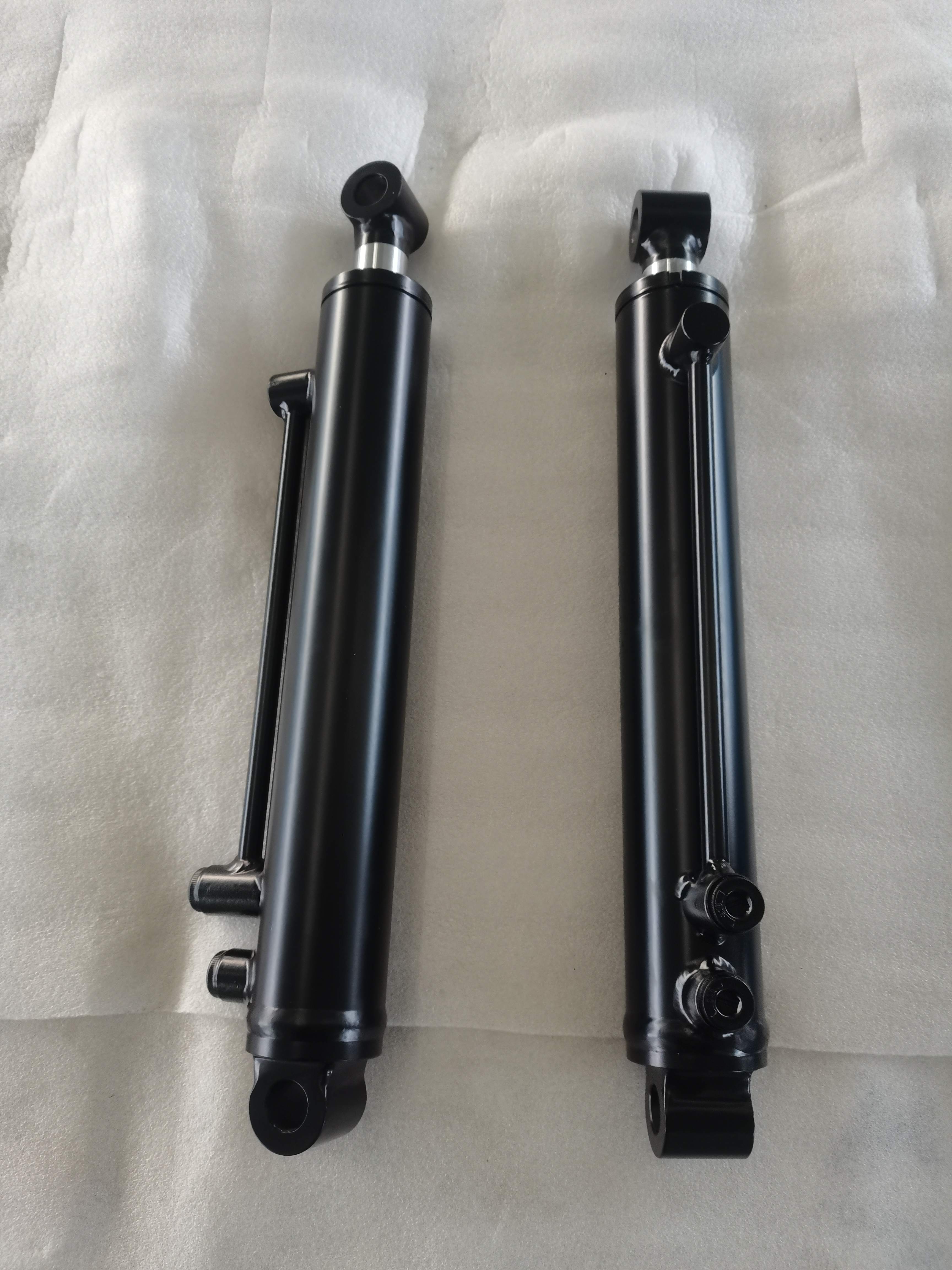
APEX-CMDC custom mill-duty hydraulic cylinder, engineered for frequent and continuous industrial operation.
#2Custom Heavy-Duty High-Pressure Hydraulic Cylinder (APEX-CHDC Series)
Ranked second for force density under severe mobile duty. This is a double-acting welded-body or application-specific design in which bore diameter, piston-rod diameter, wall thickness, rod treatment and mounting geometry are all selected from the actual load case. Piston-rod dimensions are determined by load direction, unsupported length, buckling calculation and side-load conditions, and column stability verification is required for long-stroke compression applications.
Options include single-end or dual-end cushioning, counterbalance valves, pilot-operated check valves, hose-burst valves, integrated or external relief protection, linear position transducers, magnetostrictive sensors, stroke switches, temperature sensors and heavy-duty rod scrapers for dusty, muddy and abrasive environments. Mounting styles include heavy-duty clevis, pin-eye, cross-tube, trunnion, flange and spherical bearing with replaceable bushings.
Best fit: mining and earthmoving equipment, quarry and aggregate machinery, heavy-duty dump trucks, forestry equipment, port and marine handling, oil and gas service equipment. Limitation: maximum system pressure and side-load conditions must be confirmed before engineering approval, so this type cannot be ordered from a generic pressure figure alone.
#3Custom Telescopic Hydraulic Cylinder (Front-End, Underbody and Inverted Configurations)
Ranked third because it is the only family that converts a very long stroke into a short retracted package, which is the defining constraint on tipping equipment. Three sub-types cover different machine architectures:
- Front-end (FC / FE / FEE reference series): single-acting, 3–6 stages, up to 250 bar, gravity and tipper-body load return. Listed FC models cover strokes of 3,880–8,130 mm with lifting capacities of 33–79 metric tons; listed FE models cover 3,880–7,130 mm with 30–61 metric tons; the wider front-end catalogue range is 5–100 metric tons.
- Underbody (L120 / L105 / L90 / L75): 3–6 stages, strokes of 676–2,057 mm, 200–220 bar, tipping capacities of 4–21 tons, cylinder mass of 19–51 kg, closed lengths of 367–598 mm and an induction-hardened ball connection allowing up to 30° of articulation.
- Inverted (HTC-compatible): 3,000 PSI, 7-ton or 12-ton capacity, stroke options of 78 in, 90 in, 108 in, 120 in and 144 in, gravity return, front-mounted between trailer frame and dump body.
Best fit: dump trucks, tipper trucks and tipper trailers, dump trailers, agricultural tipping trailers, mining and quarry equipment, waste and recycling vehicles. Limitation: single-acting designs depend on gravity or external load for retraction, telescopic stages must not be side-loaded, and maximum dump angle is determined by equipment geometry rather than cylinder stroke alone.
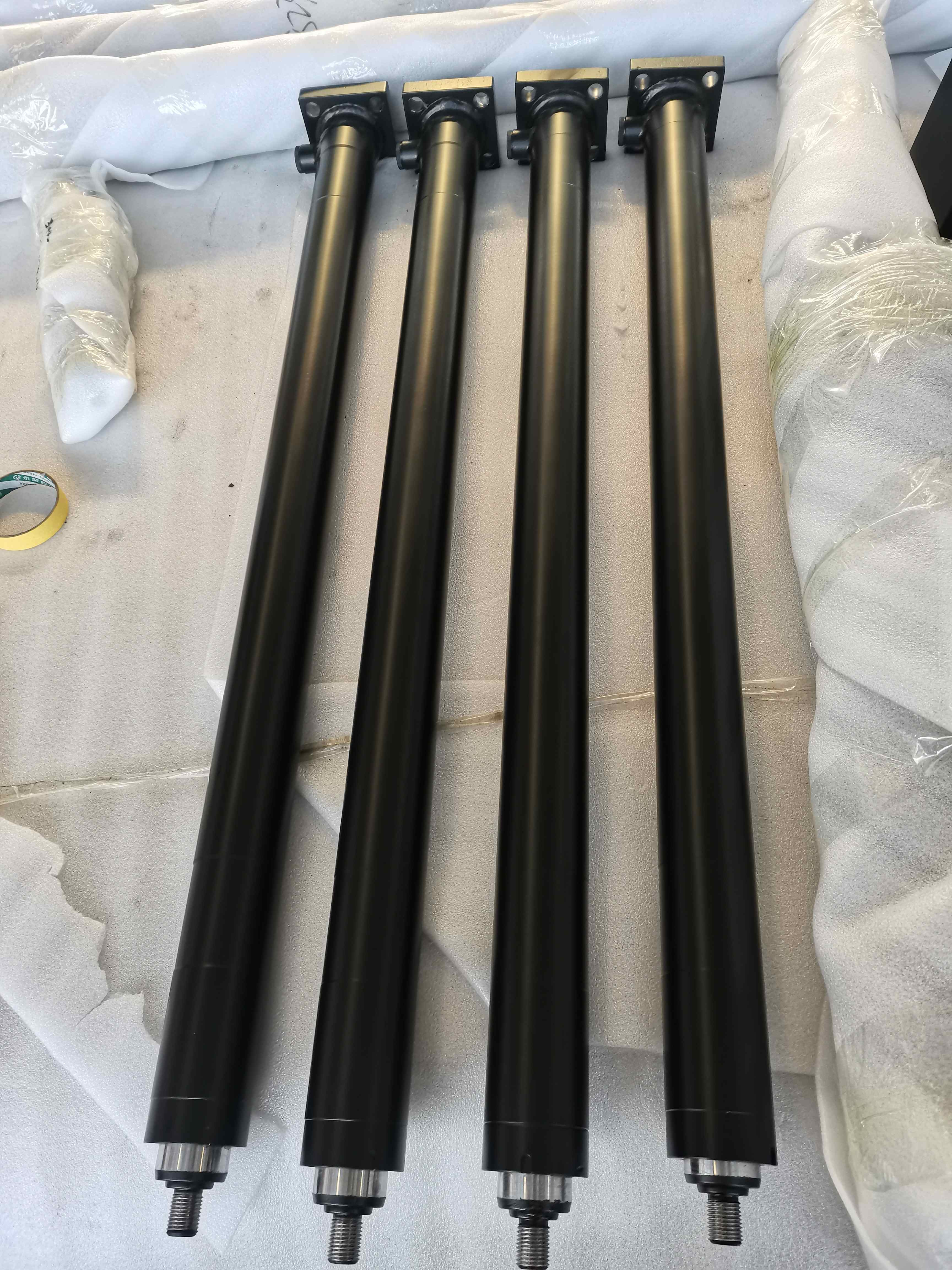
Multi-stage telescopic construction delivers long stroke from a compact retracted envelope.
#4Custom Compact Short-Stroke High-Force Hydraulic Cylinder (APEX-CCSC Series)
Ranked fourth for the highest force-to-envelope ratio in the list. Bore diameters run from 40–250 mm with strokes of 10–500 mm, working pressure of 160–250 bar, and up to 350 bar for specially engineered configurations. Body options include round, square and block type, with front flange, rear flange, foot, clevis, trunnion, threaded-body or custom mounting. Rod ends can be threaded, clevis, pin-eye, flat push plate or a custom tool interface.
Optional features include spring return for simple single-acting use, mechanical locking for load support during maintenance, anti-rotation devices, integrated valve blocks that reduce external piping, pressure-relief arrangements and short-range position sensors. Pressure, leakage and full-stroke functional testing are completed before shipment.
Best fit: industrial presses, injection molding and die equipment, clamping machinery, metal forming, machine tools, automotive production equipment, assembly and testing equipment. Limitation: stroke is short by design, and the stated duty cycle is intermittent, repeated-duty or application-specific — continuous short-stroke cycling requires engineering review.
#5Custom Position-Sensing Hydraulic Cylinder (APEX-CPSC Series)
Ranked fifth because it converts a hydraulic actuator into a measurable axis. Bore range is 40–320 mm, rod range 25–220 mm, stroke range 50–2,400 mm and working pressure up to 250 bar for the normal range, in double-acting welded, threaded-head, tie-rod or heavy-duty mill-type construction.
Feedback can be continuous through a magnetostrictive linear position transducer or an approved equivalent, or discrete through proximity switches, inductive sensors, reed switches or end-of-stroke switches, mounted internally, at the cap end or externally. Output options include analog voltage, analog current, SSI, CANbus, PWM or start/stop, with absolute or incremental feedback as required. Standard testing includes pressure, leakage, full-stroke, sensor-output and signal-repeatability tests, and documentation includes the approved drawing, sensor datasheet, wiring diagram, inspection record and test report.
Best fit: industrial automation, closed-loop construction and mining equipment, hydraulic presses, injection and forming machinery, lifting and access equipment, robotic production equipment. Limitation: the sensor package defines temperature limits, ingress protection and EMC behaviour, and controller compatibility must be confirmed against the customer’s PLC, ECU or motion controller.
#6Custom Stainless Steel Corrosion-Resistant Hydraulic Cylinder (APEX-CSSC Series)
Ranked sixth because in wet, salty and chemically aggressive environments, corrosion — not load — is the failure driver. Stainless material can be applied selectively to the barrel, piston rod, ports, mountings and fasteners according to the measured exposure rather than to the whole cylinder.
Surface options include polished, passivated, electropolished and coated finishes, with weld cleaning, pickling and passivation available. Optional drainage geometry reduces water and cleaning-fluid retention, protective rod boots add a barrier against salt and spray, and stainless-steel nameplates keep traceability readable in harsh conditions. Salt-spray, coating-thickness and material-verification documentation can be supplied according to project requirements, and every cylinder can undergo pressure, leakage and full-stroke testing before shipment.
Best fit: marine and offshore equipment, port and harbour machinery, food and beverage washdown processing, fishery and aquaculture, wastewater treatment, water control, chemical and pharmaceutical equipment, coastal construction. Limitation: chemical compatibility must be confirmed from the real cleaning agents, process chemicals and hydraulic fluid before material selection is finalised.
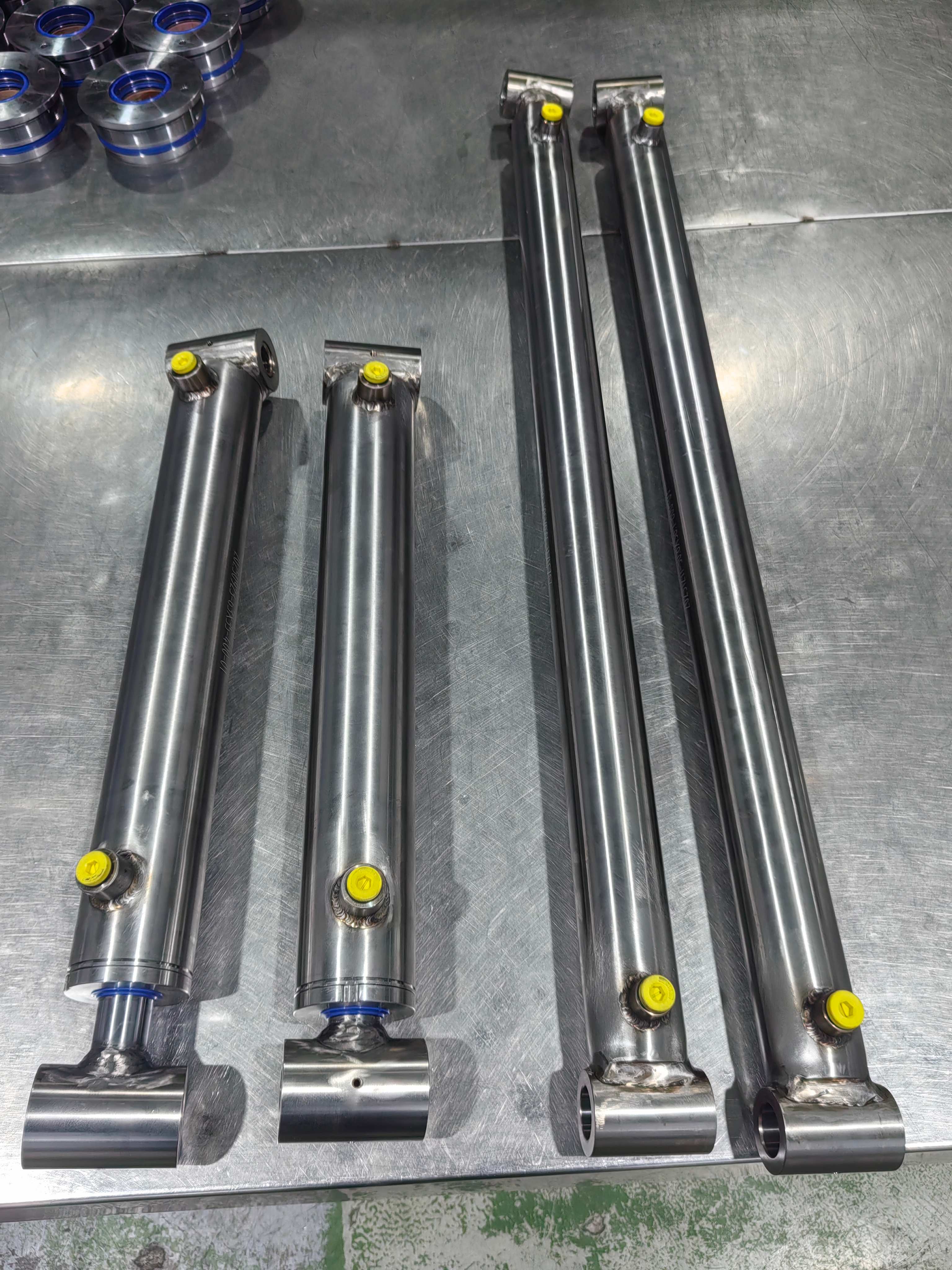
APEX-CSSC stainless steel and corrosion-resistant construction for salt spray, washdown and chemical exposure.
#7Custom Hydraulic Grapple & Attachment Cylinder (APEX-CGAC Series)
Ranked seventh as the only type in this list engineered specifically for alternating push-and-pull shock loading under continuous articulation. Heavy-duty welded construction, double acting, bore 50–250 mm, rod 30–180 mm, strokes of 100–1,500 mm, working pressure 160–350 bar with engineered configurations up to 420 bar, and an operating temperature range of -30°C to +100°C.
Design details target the real failure modes of attachment work: forged or machined rod eyes and base eyes, hardened pins and bushings, optional spherical plain bearings for limited angular movement, recessed or guarded hydraulic ports to survive impact, and heavy-duty dual-wiper scrapers that keep dust, wood chips and scrap particles out of the sealing system. Optional counterbalance valves maintain gripping force if hydraulic pressure is interrupted.
Documented programme: an Italian grapple equipment manufacturer ordered 150 custom cylinders over one year and reported improved gripping force, more stable operation and reduced maintenance under continuous heavy-duty conditions. Limitation: peak load and side-load resistance depend on attachment geometry, so linkage dimensions, mounting centres and working pressure must be supplied with the enquiry.
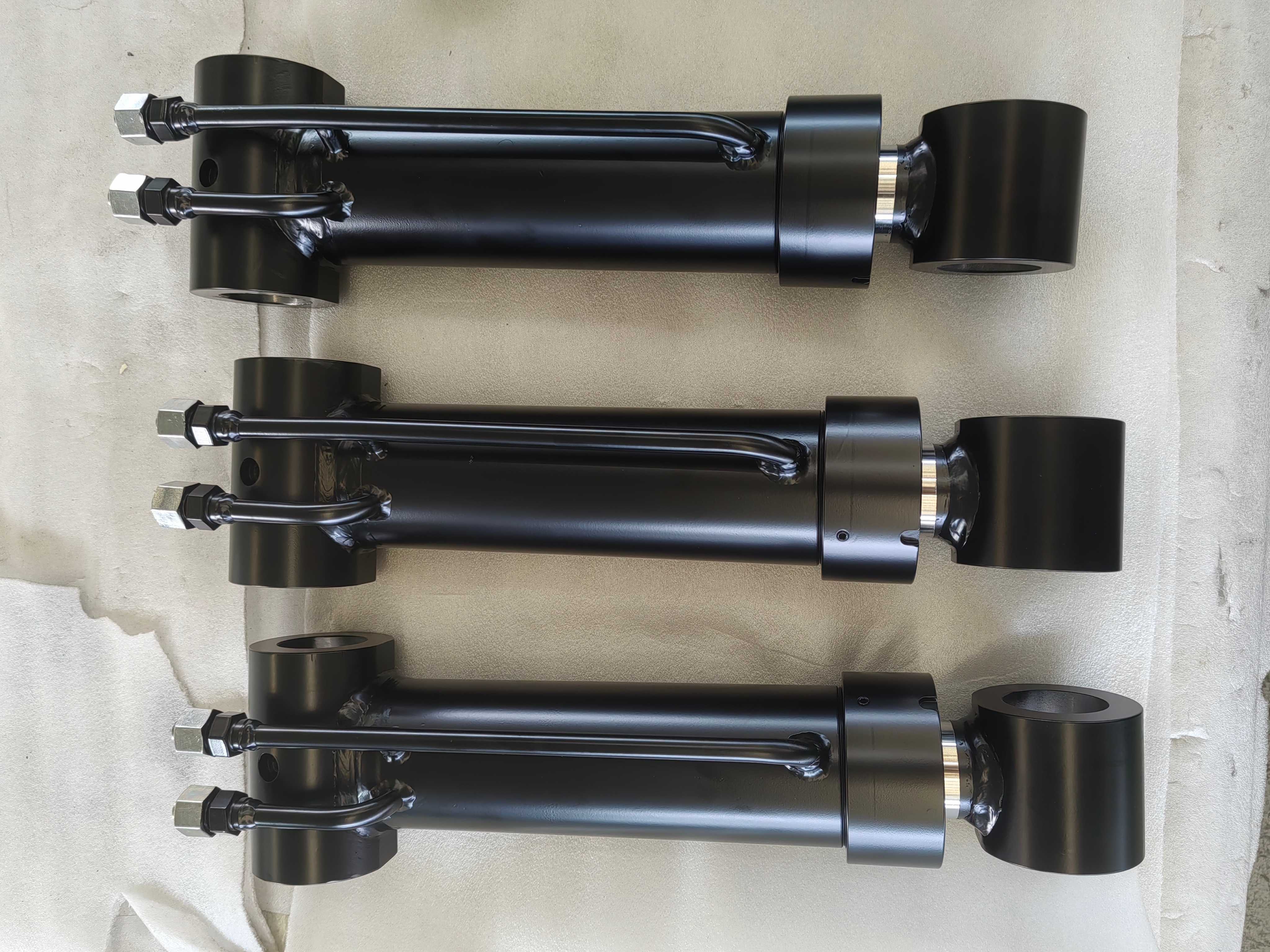
APEX-CGAC grapple and attachment cylinder, built for shock loading, articulation and contaminated environments.
#8Custom Double-Rod / Through-Rod Hydraulic Cylinder (APEX-CDRC Series)
Ranked eighth for balanced-area motion control. When both rod diameters are identical, effective area, push force, pull force, extension speed and retraction speed are equal in both directions at the same hydraulic flow, and displacement volume is identical on both sides — which simplifies symmetrical hydraulic-circuit design and repeatable bidirectional positioning.
Bore range is 32–250 mm, rod range 16–160 mm, stroke range 25–3,000 mm and working pressure 100–250 bar, with engineered designs up to 350 bar. Options include center trunnion or foot mounting, stroke offsets, cushioning at one or both ends, flow-control integration, pilot-operated check or counterbalance valves, position transducers, keyed or guided rods for anti-rotation, and dual wipers on both rod ends. Testing adds speed comparison to dimensional, pressure, leakage and full-stroke functional testing.
Best fit: industrial automation, machine tools, material handling, steering systems, metal processing machinery, hydraulic presses, testing equipment, production-line equipment. Limitation: equal performance in both directions only holds when rod diameters are matched, and the through-rod layout increases overall length for a given stroke.
#9Custom Single-Acting Ram / Plunger Hydraulic Cylinder (APEX-CSPC Series)
Ranked ninth for circuit simplicity and raw lifting capacity. Hydraulic pressure is required in one direction only, with gravity, external load, spring force or mechanical linkage providing the return — which reduces valve count, piping and control complexity in lifting and pressing duties.
Plunger or bore diameters run from 50–400 mm with guide diameters of 40–380 mm, strokes of 50–2,500 mm and working pressure of 160–350 bar, extending to 500 bar for specially engineered configurations. Options include hardened flat or spherical saddles for load contact, lock nuts or locking collars for extended holding periods, pilot-operated check or hose-burst valves, air-bleed ports, internal or external overtravel protection, and heavy-duty plunger scrapers.
Best fit: industrial lifting equipment, hydraulic presses, heavy equipment maintenance, mining and construction equipment, steel and metallurgical equipment, shipyard and railway maintenance, bridge construction and maintenance, water-control equipment, dump equipment. Limitation: installation is primarily vertical or inclined; horizontal installation and significant side loads require engineering review, and external guides are recommended where side loading is expected.
#10Custom Welded Double-Acting Hydraulic Cylinder (APEX-CWDC Series)
Ranked tenth because it is the broadest, most adaptable platform rather than the most extreme one. The APEX-CWDC Series is a fully customizable welded-body double-acting cylinder, supplied either as a build-to-print replacement or as a newly engineered OEM unit. Bore, rod diameter, stroke, pressure rating and installation dimensions all follow an approved drawing, and manufacturing is controlled against that drawing to preserve interchangeability and installation compatibility.
Ports can be SAE ORB, NPT, BSPP, BSPT, metric or flange; mounting options include cross-tube, clevis, pin-eye, trunnion, flange, foot mount and spherical bearing. Sealing materials are selected from polyurethane, NBR, PTFE, FKM or low-temperature compounds according to the operating environment. Cushioning, counterbalance or hose-burst valves, position sensing, grease fittings, custom paint, private-label identification and packaging are optional.
Best fit: agricultural machinery, construction equipment, material handling, refuse collection vehicles, dump trailers and dump trucks, forestry, mining, municipal vehicles and special-purpose vehicles. Limitation: the welded-body platform covers the widest range of duties, but the most extreme continuous industrial cycling and the most severe high-pressure mobile duty belong to the mill-duty and heavy-duty high-pressure types ranked above it.
Step-by-Step: Selecting the Right Type from This Ranking
Selection should follow a fixed sequence — duty cycle first, force and envelope second, stroke geometry third, environment fourth, feedback and load holding last. Reversing this order is the most common cause of under-specified cylinders.
- Define the duty cycle. State whether the cylinder runs intermittently, in repeated duty or continuously, and give the cycle count per shift. This single input decides whether a welded mobile platform or a mill-duty design is appropriate.
- Calculate force against the real load case. Provide normal working load, maximum peak load and required push and pull force, not just system pressure. Peak load from shock or inertia is often the sizing driver.
- Fix the envelope before the bore. Supply retracted and extended pin-to-pin dimensions, mounting width and the available installation envelope. Where telescopic stages are used, stage count and stage diameters follow from this geometry.
- Assess the environment. Record moisture, salt, washdown chemicals, dust, mud, scale, temperature range and fluid type. These determine rod treatment, wiper specification, seal compound and coating.
- Decide on feedback and load holding. If the machine needs stroke verification or closed-loop control, specify continuous or discrete feedback early, because sensor integration changes retracted length. If the load must stay held after pressure loss, specify counterbalance, pilot-operated check or hose-burst protection.
- Confirm compatibility before production. For replacement work, identification can be based on the complete reference model, original part number, verified dimensions or a physical sample, and final compatibility is confirmed before manufacturing begins.
Where the duty is moderate and a North American standard interface already exists, standard cross-reference families are often the faster route than a fully bespoke design: welded HBU, HCL and HTG configurations rated up to 3,000 PSI with cross-tube, fixed clevis or adjustable threaded clevis mounting; HTR tie-rod cylinders rated at 2,500 PSI and HTH tie-rod cylinders rated at 3,000 PSI; and S-series single-acting telescopic cylinders with a nominal 2,000 PSI rating and 2–5 moving stages.
Application Scenarios: Where Each Ranked Type Earns Its Place
Continuous loader cycling on uneven, frozen or muddy ground. Agricultural front-end loader work combines high breakout force, repeated boom and bucket cycling, vibration and abrasive ground contact. The welded double-acting type ranked tenth covers the lift and tilt functions, while the grapple and attachment type ranked seventh handles hydraulic grapple jaws that open and close on debris-laden ground where rod wiper protection matters more than maximum pressure.
Tipping and load discharge. Dump trucks, tipper trailers and dump trailers depend on the telescopic family ranked third, because the required stroke simply cannot be produced from the available retracted length by any single-stage design. Documented programmes include 180 multi-stage telescopic cylinders supplied to an Indonesian heavy-duty dump truck OEM across two years, and 1,200 sets of HTC-series telescopic cylinders plus 500 hydraulic power units supplied to a Canadian dump trailer manufacturer.
High-frequency municipal collection. Packer, sweep, slide, ejector, tailgate and container-lift functions on refuse vehicles demand shock-load and side-load resistance with reliable sealing in contaminated conditions. A documented programme covering 960 hydraulic cylinders for a US refuse truck OEM reported improved operational reliability and reduced maintenance frequency under high-frequency collection duty.
Fixed industrial production. Steel mills, presses, rolling lines and continuous casting equipment sit with the mill-duty type ranked first, while clamping, forming and assembly stations typically sit with the compact short-stroke type ranked fourth and the position-sensing type ranked fifth.
Comparison Table: 10 Custom Hydraulic Cylinder Types Ranked
| Rank & type | Acting | Documented pressure | Severe-duty strength | Watch-out | Typical fit |
|---|---|---|---|---|---|
| #1 Mill-Duty (APEX-CMDC) | Double acting | Up to 250 bar normal range | Frequent and continuous industrial cycling; fatigue defined by load spectrum; replaceable gland | Fixed industrial installation; strokes above 3,000 mm need review | Steel mills, rolling, casting, forging, paper machinery |
| #2 Heavy-Duty High-Pressure (APEX-CHDC) | Double acting | Set by approved system specification | Force density, shock capability and rod buckling verification | Side load and maximum pressure must be engineered | Mining, earthmoving, quarry, heavy dump trucks, forestry |
| #3 Telescopic (FC/FE/FEE, L-series, HTC-compatible) | Single acting | Up to 250 bar front-end; 200–220 bar underbody; 3,000 PSI inverted | Very long stroke from a short retracted envelope | Gravity or load return; no side loading; dump angle set by geometry | Dump trucks, tipper trailers, dump trailers, agricultural tipping |
| #4 Compact Short-Stroke High-Force (APEX-CCSC) | Single or double | 160–250 bar; up to 350 bar engineered | High force in a minimum envelope; optional anti-rotation and locking | Short stroke by design; continuous cycling needs review | Presses, clamping, injection molding, forming, machine tools |
| #5 Position-Sensing (APEX-CPSC) | Double acting | Up to 250 bar normal range | Integrated continuous or discrete position feedback | Sensor defines temperature, ingress and EMC limits | Automation, closed-loop equipment, presses, access platforms |
| #6 Stainless Steel Corrosion-Resistant (APEX-CSSC) | Single or double | Set by approved specification | Salt spray, washdown and chemical exposure resistance | Chemical compatibility must be confirmed first | Marine, offshore, ports, food processing, wastewater, chemical |
| #7 Grapple & Attachment (APEX-CGAC) | Double acting | 160–350 bar; up to 420 bar engineered | Alternating shock loads with continuous articulation | Peak and side load depend on attachment geometry | Scrap, recycling, forestry, demolition, municipal waste |
| #8 Double-Rod / Through-Rod (APEX-CDRC) | Double acting | 100–250 bar; up to 350 bar engineered | Equal force and speed in both directions | Requires matched rod diameters; longer overall length | Automation, machine tools, steering, presses, production lines |
| #9 Single-Acting Ram / Plunger (APEX-CSPC) | Single acting | 160–350 bar; up to 500 bar engineered | High linear force with the simplest hydraulic circuit | Return needs gravity, load or spring; vertical preferred | Lifting equipment, presses, maintenance, water control |
| #10 Welded Double-Acting (APEX-CWDC) | Double acting | Set by approved drawing | Broadest customization and compact mobile envelope | Not intended for the most extreme continuous mill duty | Agriculture, construction, material handling, refuse, dump trucks |
What a Qualified Custom Cylinder Supplier Must Document
A ranking is only useful if the supplier behind it can build and prove the design. Four evidence areas separate a capable manufacturer from a trading intermediary.
Capacity and engineering depth. Apex Hydraulic produces more than 8,000 hydraulic cylinders and 1,500 hydraulic power units per month from a 50,000 m² facility with 25 engineers covering OEM manufacturing, ODM development, custom design and hydraulic engineering solutions. Customization spans bore, rod diameter, stroke length, mounting style, working pressure, seal system, materials, surface treatment, ports and threads, paint colour, logo and packaging, plus hydraulic power unit configuration including voltage (12V / 24V / 48V), motor, pump, manifold, valve, reservoir and control system.
Quality gates. Production is controlled through incoming material inspection, in-process quality control, final quality inspection, pressure testing, leakage testing, dimensional inspection, welding inspection, surface finish inspection, functional testing and 100% final inspection. Additional documented checks applied across the range include stage-sequence testing for telescopic cylinders, speed comparison for double-rod cylinders, and sensor-output and signal-repeatability testing for position-sensing cylinders.
Compliance evidence. The CE certificate for the Hydraulic Cylinder – APCC Series, number 0P260130.AH0S46, was issued by Ente Certificazione Macchine Srl (ECM), Italy, under the Machinery Directive 2006/42/EC with applicability to the European Union and European Economic Area markets, referencing EN ISO 12100:2010 among the applicable standards.
Commercial terms. Standard products carry a minimum order quantity of 1 piece, which allows buyers to validate fit and function before committing to volume. Standard lead time is 7–20 days, custom lead time is 25–45 days, and large OEM projects follow the agreed project schedule. After-sales support covers technical consultation, engineering support, installation guidance, product documentation, spare parts supply, warranty support and long-term OEM technical partnership.
Frequently Asked Questions
What certifications and quality documentation should buyers request from custom hydraulic cylinder manufacturers?
Buyers should request the certificate itself, not a claim, together with the standard it references, the scope it covers and the issuing body. Apex Hydraulic holds a CE certificate for the Hydraulic Cylinder – APCC Series, certificate number 0P260130.AH0S46, issued by Ente Certificazione Macchine Srl (ECM), Italy, under the Machinery Directive 2006/42/EC, applicable to the European Union and European Economic Area markets. Where a project specification calls for ISO 9001, the certificate, scope statement and issuing body should be obtained directly and verified before the order is placed. Quality systems should also be evidenced by test records: incoming material inspection, in-process quality control, final quality inspection, pressure testing, leakage testing, dimensional inspection, welding inspection, surface finish inspection, functional testing and 100% final inspection before shipment.
What production capacity and customization range can a custom hydraulic cylinder manufacturer realistically support?
Apex Hydraulic produces more than 8,000 hydraulic cylinders and 1,500 hydraulic power units per month from a 50,000 m² facility staffed by 560 employees, including 25 engineers. Customization covers cylinder bore, rod diameter, stroke length, mounting style, installation dimensions, working pressure, seal system, materials, surface treatment, ports and threads, paint colour, logo and packaging, and extends to complete hydraulic power unit configuration including voltage (12V / 24V / 48V), motor, pump, manifold, valve, reservoir and control system. The practical limit is not component choice but evidence: each custom design is manufactured against an approved drawing, and parameters such as bore, rod diameter and stroke are calculated from the required output force, load, buckling condition and installation envelope.
What drives the cost of a custom hydraulic cylinder for demanding industrial applications?
Cost is driven by the engineering inputs, not by the cylinder’s length alone. The main drivers are bore and rod diameter (material volume and machining time), steel grade and wall thickness for the pressure and fatigue requirement, piston-rod surface treatment such as hard chrome or induction-hardened chrome, seal compound selection for temperature and fluid, mounting complexity such as forged clevis, trunnion or spherical bearing, integrated valves and cushioning, and the extent of testing and documentation required. Order quantity and the mix of standard versus custom configuration also influence the outcome. Two commercial terms reduce buyer risk: standard products carry a minimum order quantity of 1 piece, so a single unit can be validated before a volume commitment, and OEM or customized quantities are negotiable according to project requirements.
Can a supplier produce a single custom cylinder or sample before a full production order?
Yes, within the limits of the configuration. Standard products have a minimum order quantity of 1 piece, and OEM or customized quantities are negotiated according to project requirements. For replacement work, production can be based on a complete reference model, original part number, verified installation dimensions or a physical sample, and several series are expressly designed for sample-based or drawing-based reverse engineering. Apex Hydraulic manufactures against an approved drawing so that interchangeability and installation compatibility are controlled. Because every finished cylinder can undergo dimensional inspection, extension testing, pressure testing and leakage testing before shipment, a sample unit arrives with the same verification applied to a production batch.
What are typical lead times for standard and custom hydraulic cylinders?
Apex Hydraulic publishes a standard product lead time of 7–20 days and a customized product lead time of 25–45 days, while large OEM projects follow the agreed project schedule. The difference reflects what custom work involves: engineering review of the load case, drawing approval, material and seal selection, and additional inspection steps. To keep a custom order on schedule, prepare the installation data up front — equipment type, cylinder function, existing part number if available, retracted and extended pin-to-pin lengths, available envelope, required push and pull force, normal and peak load, working and maximum system pressure, mounting style and pin diameter, port type and position, operating temperature, fluid type, duty cycle, corrosion-protection requirement and annual demand. Sending these with the enquiry is the fastest way to move from specification to a firm lead time; you can send the details directly through WhatsApp or email them to jason@hydraulicapex.com for review.
Conclusion
The ten types above are not interchangeable options on a price list. They are answers to specific combinations of duty cycle, force, geometry, environment and control. Mill-duty and heavy-duty high-pressure cylinders rank highest because they are engineered for the load cases that destroy general-purpose cylinders. Telescopic designs rank third because they solve a geometric problem no single-stage cylinder can solve. The remaining seven cover the specific severe-duty conditions found in industrial automation, marine and washdown environments, attachment work, synchronized motion, vertical lifting or the widest range of mobile equipment duties.
Whichever type the application calls for, the same two questions decide the outcome: is the design calculated from the real load case, and can the supplier document the materials, tests and dimensional control behind it? Apex Hydraulic manufactures custom hydraulic cylinders and hydraulic power units against approved drawings, with documented quality gates, a published CE certification for the APCC Series, capacity of more than 8,000 cylinders per month and a custom lead time of 25–45 days.
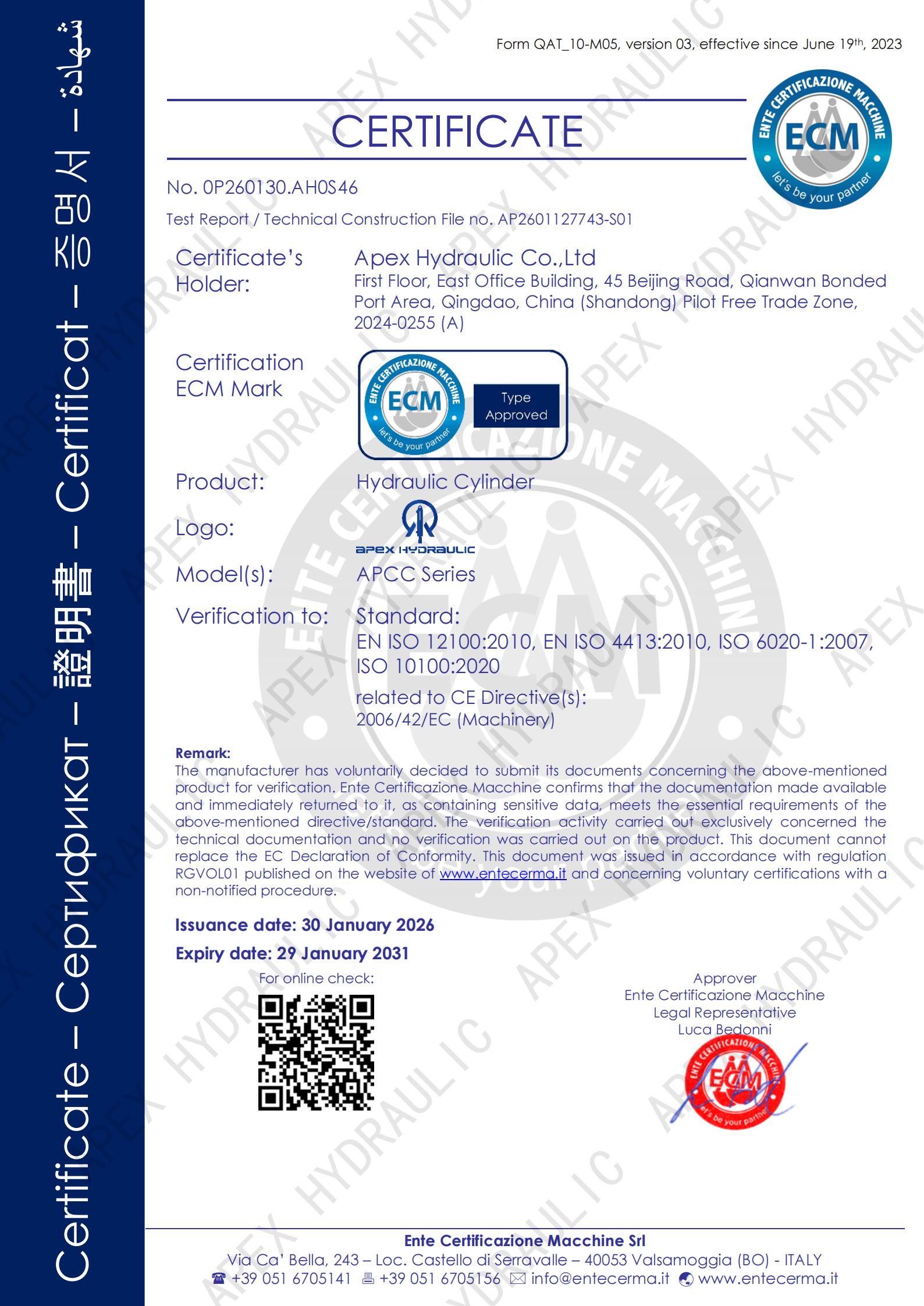
CE certification for the Hydraulic Cylinder – APCC Series, certificate 0P260130.AH0S46, issued by ECM Italy.
Next step: match a cylinder type to your duty cycle
Send your equipment type, cylinder function, mounting dimensions and load data, and the engineering team will confirm which of the ten ranked types applies — plus a quotation and lead time for that configuration.
Contact: Jason | Email: jason@hydraulicapex.com | Tel / WhatsApp: +86 182-5318-1828
Apex Hydraulic Co., Ltd., Qingdao City, Shandong Province, China | www.hydraulicapex.com
Download the full product catalogue: APEX Hydraulic Product Catalog (Main Products)
Have Questions or Need More Details?
Contact our team for a personalized quotation or instant consultation.
Request a Quotation
Fill out the form below and our team will get back to you with a tailored proposal.
WhatsApp Direct Chat
Prefer to chat in real-time? Message us on WhatsApp for instant assistance & quick answers.
- Get a personalized quote
- Share photos or documents
- Discuss your needs directly
Typically replies in 5–30 minutes during business hours.