Hydraulic Power Unit Basics: What to Know Before Choosing a Supplier
Hydraulic Power Unit Basics: What to Know Before Choosing a Supplier
A hydraulic power unit is a self-contained system that supplies pressurized hydraulic fluid to actuators such as cylinders and motors. In short, it is the part of a hydraulic system that generates flow and pressure to move or control mechanical equipment. The global hydraulic power unit market is a significant industrial segment, with estimates placing its 2024 market size between USD 11.4 billion and USD 13.6 billion. Because buyers use terms like hydraulic power pack, mobile hydraulic power unit, DC hydraulic power unit, and custom OEM hydraulic power unit interchangeably, understanding the basic categories and supplier evaluation criteria helps avoid costly specification errors.
This article explains what hydraulic power units are used for, the main product types buyers encounter, what a supplier should be able to document, and how to evaluate a manufacturer before sending an RFQ. It is written for equipment manufacturers, distributors, and procurement teams at the Awareness and Research stages of the buying process.
What Is a Hydraulic Power Unit?
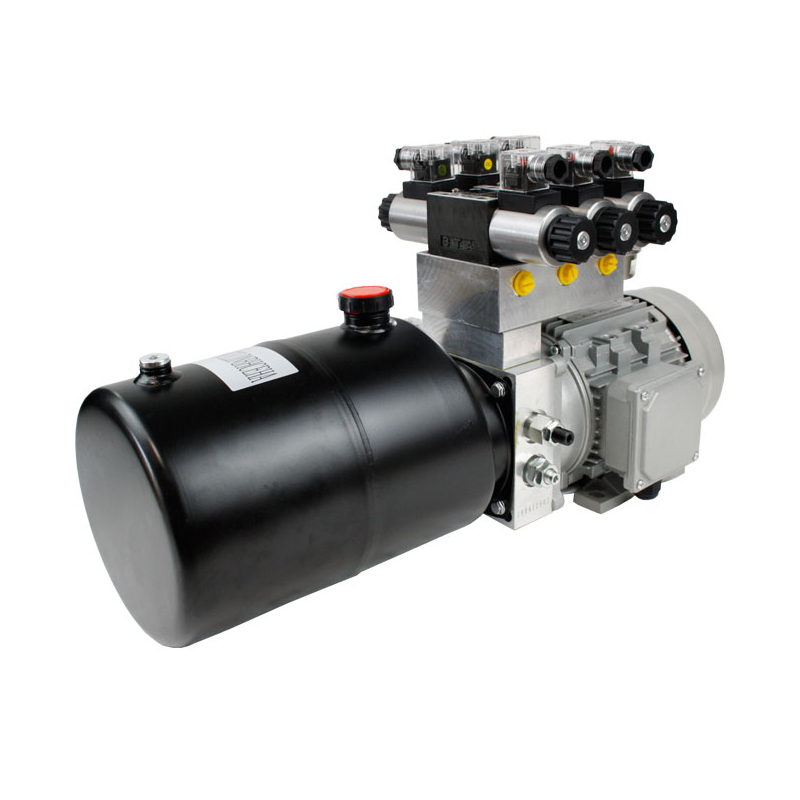
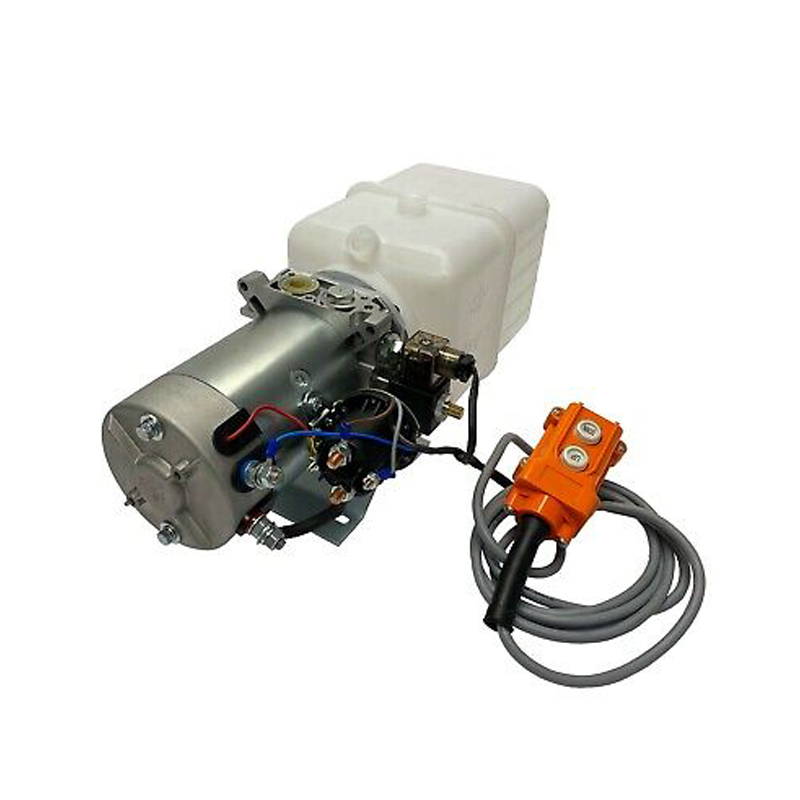
A hydraulic power unit (HPU) combines an electric motor, a hydraulic pump, a reservoir, control valves, and usually a manifold into one package. The motor drives the pump, the pump draws oil from the reservoir, and the control valves direct the oil to the connected hydraulic cylinder or motor. Depending on the design, an HPU can support single-acting, double-acting, or multi-function hydraulic circuits.
Hydraulic power units are widely used in both stationary and mobile equipment. Common examples include industrial machinery, lift tables, scissor lifts, material handling equipment, dump trailers, refuse collection vehicles, aerial work platforms, and special-purpose trucks. From a buyer's perspective, the HPU is often the most convenient way to add hydraulic motion to a machine because it arrives as a tested package rather than a collection of loose components.
Why the Hydraulic Power Unit Market Is Growing
Multiple third-party research firms track the hydraulic power unit industry, and their estimates vary slightly. Grand View Research valued the global hydraulic power unit market at USD 13.6 billion in 2024, while Precedence Research estimated USD 11.4 billion in the same year with a projected CAGR of 5.5% through 2034. The variation is normal because research firms use different scopes and methodologies. The shared conclusion is that the market is large and growing.
Regional data reinforces this picture. Grand View Research reports that Asia Pacific accounted for 40.2% of the global revenue share in 2024. In the United States, the hydraulic power unit market was valued at USD 2.55 billion in 2024, with electric-powered units dominating at 60.1% of revenue. The 2,000–3,000 psi pressure range is also projected to grow at a CAGR of 5.8% from 2025 to 2033, according to the same research firm.
For buyers, these figures suggest that hydraulic power units are not a niche product category. A broad supplier base exists, and standardization is high enough that procurement teams can compare specifications across manufacturers.
Problem Definition: Why Buyers Struggle to Select a Hydraulic Power Unit
Choosing a hydraulic power unit appears straightforward at first because the product seems simple: a motor, a pump, a tank, and a valve block. In practice, buyers frequently run into several problems.
- Terminology confusion: The same product is called a hydraulic power pack, a power unit, a pump station, or a DC electro-hydraulic power unit, which makes searching and comparing difficult.
- Application mismatch: A power unit designed for indoor industrial use may not survive outdoor vehicle-mounted conditions involving vibration, moisture, and road salt.
- OEM integration gaps: Equipment manufacturers rarely need a generic catalogue product. They need a unit with the right manifold, port configuration, control interface, and mounting dimensions. A standard product can create installation and performance problems.
- Supplier verification difficulty: Because hydraulic power units are engineered products, buyers need evidence of design capability, manufacturing quality, and testing procedures. Marketing language alone is not sufficient.
The solution is not simply to find any supplier, but to understand the categories that match your application and to evaluate suppliers against verifiable criteria.
Industry Background: How Hydraulic Power Units Are Used by Market Segment
Hydraulic power unit applications span multiple industries. Grand View Research found that the industrial application segment held 56.3% of the U.S. market revenue share in 2024. This includes manufacturing equipment, machine tools, presses, conveyor systems, and factory automation. Although the industrial segment is the largest, mobile applications such as dump trailers, refuse trucks, agricultural machinery, and aerial work platforms account for a substantial share of OEM demand.
Within mobile applications, voltage is a key differentiator. Many vehicle-mounted and trailer-mounted units use 12 VDC or 24 VDC electric motors because they can run directly from a vehicle battery or deep-cycle battery. 48 VDC systems are also available for higher-power mobile applications, and AC-powered units remain the standard for stationary industrial equipment where mains electricity is available.
Main Types of Hydraulic Power Units
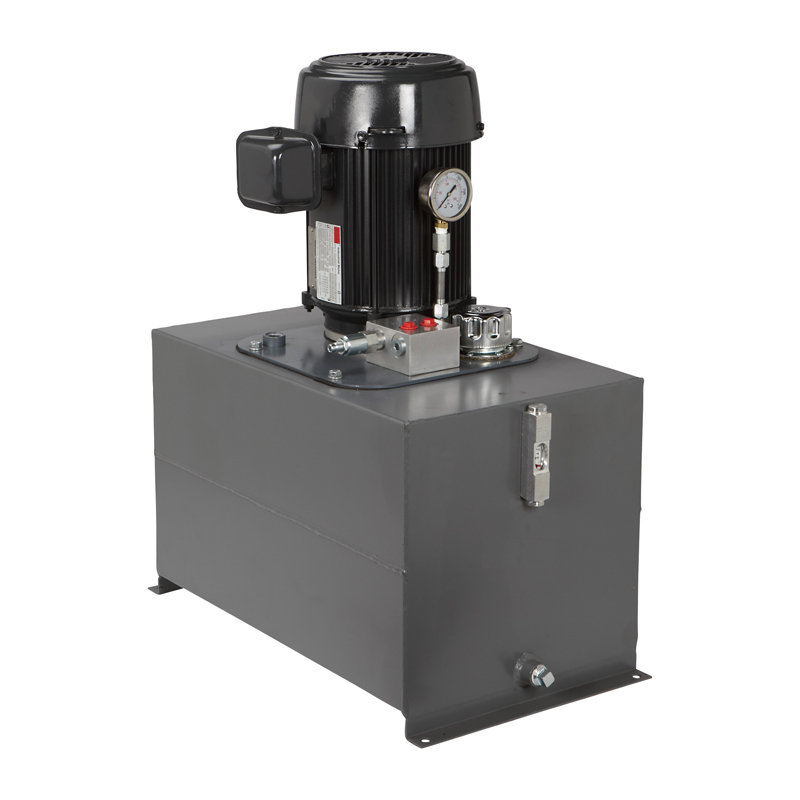
Hydraulic power units can be grouped by power source, hydraulic function, and operating environment. Understanding these groups helps buyers communicate their requirements clearly.
By Power Source
- AC hydraulic power units: Powered by 220 VAC or 380 VAC, single-phase or three-phase, at 50 Hz or 60 Hz. Typically used in industrial automation, manufacturing equipment, hydraulic presses, machine tools, lift tables, dock levelers, and other fixed machinery.
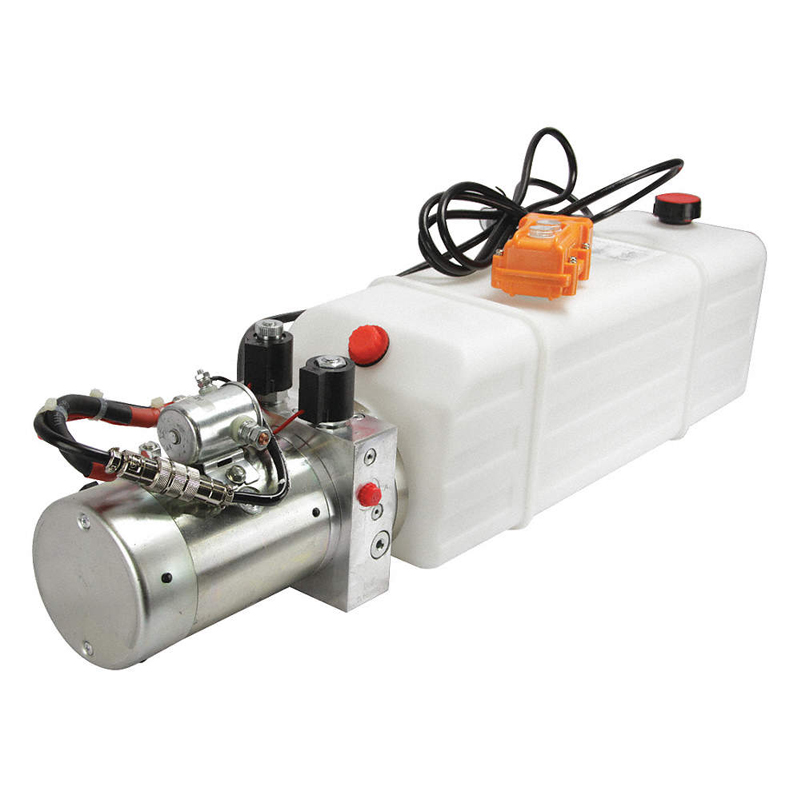
- DC hydraulic power units: Powered by 12 VDC, 24 VDC, or 48 VDC. Used in mobile equipment such as dump trailers, scissor hoists, refuse collection vehicles, and vehicle-mounted lifting systems.
By Hydraulic Function
- Single-acting power-up / gravity-down: The pump extends a single-acting cylinder, and lowering is controlled by gravity returning oil through a solenoid valve. Common in dump trailer applications.
- Double-acting power-up / power-down: The power unit supplies oil to both sides of a double-acting cylinder, providing powered extension and powered retraction. Suited to scissor hoists, tilt-bed trailers, and equipment requiring controlled lowering.
- Multi-function systems: Integrated manifolds with 2-way, 3-way, or 4-way solenoid valves support multiple hydraulic functions such as lifting, steering, leveling, and outrigger control from one power unit.
By Application
- Industrial hydraulic power units: Stationary, continuous-duty or intermittent-duty units for factory equipment.
- Mobile hydraulic power packs: Compact DC-powered units for trailers, vehicles, and mobile machinery.
- Compact and low-noise units: Smaller reservoirs and motors designed for medical equipment, patient lifts, accessibility lifts, and noise-sensitive indoor environments.
- Vehicle-mounted auxiliary units: Higher-voltage DC units for refuse trucks, utility vehicles, tailgates, cranes, and special-purpose vehicles.
Key Specifications to Compare
Before contacting a supplier, buyers should compare a core set of specifications. The table below summarizes the main specification ranges found in the Apex Hydraulic product family. These are intended as reference parameters, not as a universal industry standard.
| Specification | Common Range | Selection Consideration |
|---|---|---|
| Rated voltage | 12 VDC / 24 VDC / 48 VDC / 220 VAC / 380 VAC | Mobile equipment usually requires DC; stationary industrial equipment usually requires AC. |
| Motor power | 0.12–8.0 kW depending on unit type | Match power to pump displacement, pressure, and duty cycle. |
| Maximum working pressure | Approx. 230–280 bar (3,335–4,000 PSI) | Pressure must cover the required actuator force with margin for relief-valve setting. |
| Flow rate | Approx. 1–40 L/min depending on unit | Flow determines actuator speed; higher flow needs larger ports and hoses. |
| Reservoir capacity | 0.5–60 L depending on unit | Larger reservoirs help cooling and oil volume, but take up more installation space. |
| Duty cycle | Intermittent or continuous | Frequent or long operating cycles require continuous-duty or higher-capacity cooling. |
| Hydraulic functions | 1–8 functions | Multi-function manifolds reduce external hoses and simplify machine integration. |
| Ingress protection | IP54 / IP55 / IP65 / IP66 | Outdoor and wet environments require higher IP ratings and sealed electrical connectors. |
| Port types | SAE ORB / NPT / BSPP / Metric | Must match the hoses and fittings used in the target market or existing machine design. |
| Fluid cleanliness | ISO 4406 20/18/15 | Filtration reduces contamination-related failures in pumps and valves. |
Optional Features That Change System Performance
Beyond the core specifications, optional valves and accessories significantly affect safety, controllability, and installation cost. Buyers should ask whether these features are available and whether the supplier can integrate them into a single manifold.
- Load-holding valves: Pilot-operated check valves, counterbalance valves, and hydraulic locks help hold the load when the pump is not running.
- Flow control: Pressure-compensated or proportional flow control valves provide smoother speed control, especially for lifting and lowering operations.
- Pressure control: Adjustable pressure relief valves are standard; pressure reducing valves and proportional pressure control are optional.
- Emergency functions: Manual emergency lowering, emergency hand pumps, and emergency auxiliary power functions support safe operation during power failure.
- Filtration and cooling: Return-line filters, suction strainers, oil coolers, and heaters protect the system and extend component life.
- Sensing options: Oil level indicators, temperature sensors, and pressure sensors can be integrated for monitoring and automation.
Standard vs. Custom Hydraulic Power Units
Standard packaged units account for a significant portion of the global hydraulic power unit market. According to Mordor Intelligence, standard packaged units represented 47.8% of the global revenue share in 2024. These units are convenient when the application fits a catalogue specification.
However, OEM equipment manufacturers often need a custom hydraulic power unit because their installation space, control system, port configuration, and performance requirements are unique. Customization may include reservoir shape and size, manifold design, valve selection, wiring harnesses, mounting brackets, color, and labelling. A supplier that offers OEM/ODM service with product design, engineering drawings, prototype development, testing, and quality inspection can support this process more effectively than a supplier that only sells standard packs.
Step-by-Step: How to Evaluate a Hydraulic Power Unit Supplier
At the Awareness and Research stages, buyers do not need to finalize a purchase. They need a framework for building a qualified supplier shortlist. The following seven steps cover the most important checks.
Step 1: Define the Application Clearly
Start with the machine type and operating environment. Common industry labels include aerial work platforms, material handling equipment, construction equipment, dump trailers, refuse collection vehicles, and medical equipment. Each application carries different requirements for pressure, flow, duty cycle, ingress protection, and noise.
A useful exercise is to write down: What equipment will the HPU power? What hydraulic functions are required? Will the unit run indoors or outdoors? What voltage is available? What space is available?
Step 2: Compare Product Category Fit
Review the supplier's product categories to ensure they have experience in your application. For example, a low-noise compact hydraulic power unit is suited to medical equipment and patient lifting; a vehicle-mounted auxiliary unit is designed for refuse trucks and special-purpose vehicles; a 12V dump trailer power unit is built for single-acting telescopic cylinders; and an AC industrial unit is suited to factory automation.
Step 3: Check Engineering Support
For custom projects, engineering capability matters more than catalogue breadth. Ask about the R&D team size, whether they provide product design and engineering drawings, whether prototype development is available, and how they manage changes before production approval.
Step 4: Verify Manufacturing Capability
Manufacturing capability is not just about factory area or employee count. It is about having the equipment and process control to produce consistent quality across production batches. Buyers can ask about annual production capacity, key manufacturing processes, and quality inspection procedures. A manufacturer that produces both cylinders and power units can simplify supply chains and improve system matching.
Step 5: Confirm Testing and Documentation
A reliable supplier should perform pressure, leakage, electrical, valve-function, and full-cycle testing before shipment. Documentation such as approved drawings, inspection records, and test reports should be available on request. This is especially important for OEM buyers who need traceability for their own equipment quality systems.
Step 6: Evaluate Customization Flexibility
Check whether the supplier can customize manifolds, wiring harnesses, mounting brackets, reservoirs, control interfaces, and electrical cabinets. In mobile applications, features like CAN Bus control, wireless remotes, and weather-resistant enclosures can be critical.
Step 7: Compare Total Ownership Factors
Price is only one factor. Consider the cost of integrating the unit, commissioning time, spare parts availability, warranty support, technical documentation, and responsiveness of communication. A supplier that answers technical questions quickly and provides clear proposals reduces project risk.
Use Cases: Where Custom Hydraulic Power Units Are Required
Use Case 1: Dump Trailer Manufacturing
Dump trailer manufacturers typically need a 12 VDC or 24 VDC hydraulic power unit with a single-acting power-up / gravity-down circuit. The power unit must be compatible with a front-mount telescopic cylinder or an underbody scissor hoist, and it must fit into a compact trailer pump box. A removable pendant, optional wireless remote, and a translucent reservoir for quick oil-level checks are practical features in this market.
Use Case 2: Aerial Work Platforms
Aerial work platforms require multi-function hydraulic power units that integrate lifting, steering, platform leveling, and outrigger control into one manifold. DC voltage options and standard intermittent duty cycles (for example, 1 minute on-load / 9 minutes off-load) are common. Emergency lowering and emergency auxiliary power functions improve safety for personnel working at height.
Use Case 3: Special-Purpose and Municipal Vehicles
Refuse collection vehicles, road maintenance trucks, utility trucks, and truck-mounted cranes need vehicle-mounted auxiliary hydraulic power units. These units operate in outdoor environments with vibration, road shock, dust, rain, and sometimes corrosive road salt. Weather-resistant enclosures, sealed electrical connectors, and corrosion-resistant fittings are often necessary.
Use Case 4: Industrial Machinery and Automation
Industrial applications range from hydraulic presses and machine tools to lift tables, dock levelers, and waste compaction equipment. AC-powered units with CETOP modular valve blocks allow circuit expansion and easier maintenance. Continuous-duty configurations with oil coolers are available for demanding operating cycles.
Hydraulic Power Unit Supplier Evaluation at a Glance
The table below summarizes the main checks buyers can use when comparing potential manufacturers. Only include suppliers that pass the technical and documentary checks, not just the commercial ones.
| Evaluation Area | What to Look For | Why It Matters |
|---|---|---|
| Product range | AC, DC, compact low-noise, vehicle-mounted, dump trailer, multi-function units | Evidence of experience across different hydraulic applications. |
| Customization | OEM/ODM, custom manifold, custom electrical control, custom wiring harness, mounting brackets | Determines how easily the power unit can be integrated into your equipment. |
| Engineering | Product design, engineering drawings, prototype development, testing | Shows whether the supplier can support a design-from-scratch or build-to-print project. |
| Manufacturing | Production capacity, quality control process, in-house processes | Affects lead time, consistency, and the supplier's ability to scale with your demand. |
| Testing | Pressure, leakage, electrical, valve-response, full-cycle testing before shipment | Reduces the risk of field failures and warranty issues. |
| Documentation | Approved drawings, inspection records, test reports, traceability labels | Important for OEM quality systems and future replacement orders. |
| Communication | Technical responses, proposal clarity, responsiveness | Indicates how smoothly the project will run, especially for custom orders. |
What to Ask a Hydraulic Power Unit Supplier Before an RFQ
Even before sending a formal request for quotation, buyers can use the following questions to qualify suppliers.
- Which industries are your hydraulic power units designed for?
- Can you provide a custom manifold and custom electrical control for our application?
- Do you offer OEM/ODM services including design, prototype, testing, and production?
- Which voltages, pressures, flow rates, and reservoir capacities are available in your product range?
- What testing is performed on each completed power unit before shipment?
- Can you supply approved drawings, test reports, and traceability documentation?
- Do you offer wireless remote control, CAN Bus, load-holding valves, or emergency lowering options?
Example: A Supplier with Full HPU Capability
Apex Hydraulic Co., Ltd. is a China-based manufacturer established in 2009, located in Qingdao City, Shandong Province. The company supplies custom hydraulic cylinders, hydraulic power units, hydraulic systems, and hydraulic scissor hoist kits to equipment manufacturers and distributors in North America, Western Europe, South America, Southeast Asia, the Middle East, and Australia. Its R&D team includes 25 engineers, and the manufacturing facility covers 50,000 square meters.
Apex Hydraulic reports an annual production capacity of 100,000 hydraulic cylinders and 15,000 hydraulic power units. Its product family includes the APEX-CLNCHPU low-noise compact unit, the APEX-CDAMHPU double-acting mobile unit, the APEX-DTHPU 12V dump trailer unit, the APEX-CMFHPU multi-function aerial work platform unit, the APEX-CVMAHPU vehicle-mounted auxiliary unit, and the APEX-ACHPU Series industrial unit. All units can be supplied with custom manifolds, custom wiring or electrical controls, and OEM/ODM services as required.
For buyers, this type of supplier profile is relevant not because of the brand name, but because it demonstrates the combination of engineering support, manufacturing scale, and product coverage that a custom HPU project typically requires.
Limitations and Selection Risks to Keep in Mind
Even a well-designed hydraulic power unit will fail if the system is not matched to the application. Keep these limitations in mind.
- Duty cycle is not optional. An intermittent-duty unit is not appropriate for continuous operation without engineering review.
- Pressure and flow are not independent. Increasing pressure reduces the flow the motor can deliver; the pump, motor, and relief valve must be selected as a set.
- Installation environment changes everything. A unit rated for an indoor industrial environment may not survive outdoor vehicle mounting without weather-resistant enclosures and sealed connectors.
- Hydraulic fluid and operating temperature must match the components. Ask about recommended fluid viscosity and temperature ranges such as −20°C to +80°C.
- Port configuration is more important than it looks. Using mismatched port types (SAE ORB vs. NPT vs. BSPP) creates installation delays and potential leakage.
Conclusion
A hydraulic power unit is the heart of any hydraulic actuation system. The market is large, the terminology is broad, and the technical choices are significant. Buyers who take the time to define their application, compare specifications, and evaluate suppliers on engineering and testing capability will make better procurement decisions than those who rely on catalogue prices alone.
The next practical step is not to place an order immediately, but to build a shortlist of suppliers that can demonstrate relevant product experience, custom engineering support, and documented testing processes. If you need a starting point, download the Apex Hydraulic Product Catalog to review the available product types, parameters, and customization options, or contact the Apex Hydraulic team to discuss your application.
Need help matching a hydraulic power unit to your equipment?
Contact Apex Hydraulic for engineering feedback, reference specifications, or a quotation. Email: jason@hydraulicapex.com | Tel/WhatsApp: +86 182-5318-1828
OEM and ODM projects are welcome.
FAQ
Define your equipment type, hydraulic functions, available voltage, maximum working pressure, flow rate, installation space, and operating environment. Compare each supplier's product categories against these requirements. For example, a 12 VDC dump trailer power unit is designed for power-up / gravity-down circuits with single-acting cylinders, while an AC industrial unit is designed for stationary machinery with mains electricity. Clear application details also help the supplier provide a more accurate RFQ response.
In practice, the two terms are used interchangeably. A hydraulic power unit (HPU) and a hydraulic power pack describe the same kind of self-contained assembly: a motor, pump, reservoir, and valves that supply pressurized oil to hydraulic actuators. Some manufacturers use "power pack" for compact DC-powered units and "power unit" or "pump station" for larger AC-powered industrial systems, but this is a naming convention rather than a technical distinction.
Choose a standard unit when your voltage, pressure, flow, reservoir size, port configuration, and installation space fit an existing catalogue model. Choose a custom unit when the machine requires a specific manifold, multi-function valve circuit, mounting bracket, wiring harness, control interface, or unique reservoir shape. OEM/ODM suppliers with engineering support can produce custom designs based on your equipment geometry and performance requirements.
A reliable supplier should perform pressure testing, leakage inspection, electrical testing, valve-function testing, and full-cycle functional testing before shipment. For example, Apex Hydraulic states that each completed power unit undergoes pressure, leakage, electrical, valve-response, and full-cycle testing depending on product type. Buyers should ask for test reports and inspection documentation as part of the order qualification process.
Review the supplier's engineering capability, manufacturing capacity, customization services, and testing process. Confirm that they can provide product design, engineering drawings, prototype development, and quality inspection. Check whether they offer OEM/ODM service, custom manifolds, custom electrical controls, and custom wiring harnesses. Annual production capacity and export experience to your target region are also useful indicators. Finally, ask for drawings, test reports, and reference documentation before committing to a production order.
Have Questions or Need More Details?
Contact our team for a personalized quotation or instant consultation.
Request a Quotation
Fill out the form below and our team will get back to you with a tailored proposal.
WhatsApp Direct Chat
Prefer to chat in real-time? Message us on WhatsApp for instant assistance & quick answers.
- Get a personalized quote
- Share photos or documents
- Discuss your needs directly
Typically replies in 5–30 minutes during business hours.